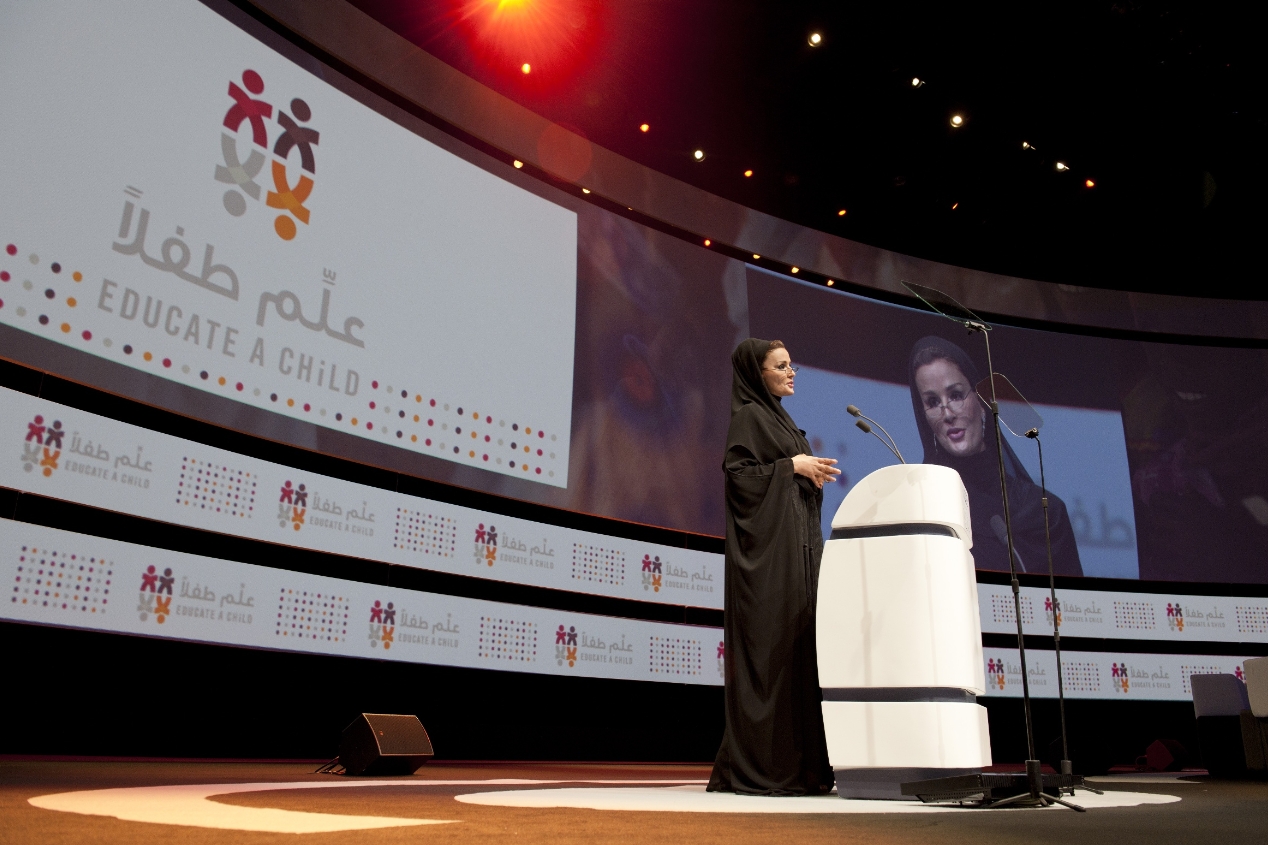
With millions of school-going age children worldwide still without access to education, it is small wonder the annual World Innovation Summit for Education (WISE) keeps drawing global attention. Anver Versi was at th e 2012 summit in the Qatari capital Doha where, once again, seeking solutions to educational needs was at the heart of the agenda.
Although I had of course heard about the WISE global initiative in Doha, Qatar, and was looking forward to attending its fourth annual summit in November, I must admit I was not prepared for what was lying in wait for me when I got there.
For the three days of the summit, the vast conference venue had been converted into a universe of education crammed with educators and policy makers of every description and seemingly from every corner of the earth all bent towards one goal – how to spread the liberating light of education where there is still darkness. And darkness there is still plenty of – an estimated 670 million children of school-going age around the world see their prime learning years tick by untouched by any form of education. Millions more snatch whatever little bits and pieces of learning that come their way as they and their parents battle poverty, conflict and hostile environments.
This is despite the fact that over 80 years ago, the Human Rights Convention declared education as a basic human right. Education liberates, the lack of it enslaves the mind and crushes the human spirit. The hunger for education can be as acute and urgent as the need for food and water.
Perhaps it was this awareness and the look of deep longing in the eyes of children shut out of classrooms, that drove Sheikha Moza bint Nasser, wife of the Emir of Qatar, Sheikh Hamad bin Khalifa Al-Thani, to set up, four years ago, WISE as part of the Qatar Foundation which she chairs. The aim was simple in principle but breathtaking in scope: bring together the world’s most creative minds in the field of education and hammer out practical ideas that will begin to push back the boundaries of ignorance that still plague large parts of the world.
WISE is a year-long series of programmes culminating in the annual summits where outstanding achievements in the field of innovative education are recognised and awards presented.
This was a commitment driven by passion and the Sheikha’s enormous energy. Over the years, WISE has quickly developed into a global community of like-minded people ranging from multilateral organisations such as UNESCO and the World Bank, to some of the world’s greatest universities and teaching organisations, to NGOs and to some of the most extraordinary individuals who have defied every obstacle imaginable to educate children who would otherwise have been left out in the cold.
“You have heard the statistics – over 60 million children are currently deprived of access to education. The figures are hard to comprehend,” said Sheikha Moza, launching her Educate a Child campaign. “But imagine this – that number is the same as the populations of Beijing, London, Paris, Cairo and Karachi combined. Behind these numbers are countless real-life stories. Stories of disadvantage, poverty, conflict, of disaster. But also stories of courage, of resilience, of determination.”
She told us that she had visited the Kakuma refugee camp in Kenya where hundreds of thousands of families fleeing conflicts in the Horn are being looked after. Here she met Suad Shariff Mohammed, the head teacher of the Horseed Primary School. She is responsible for the education of 1,400 children of different nationalities, cultures and faiths but has only 25 teachers. “Some are teaching classes of 168 pupils in a single crowded space, without electricity, without pencils. Even without chairs or desks,” Sheikha Moza recalled. “For many of us, learning in these conditions can seem impossible. But for Suad and the other teachers, nothing is impossible. They use their creativity. When they lack writing materials, they teach through song or drama.”
Suad herself grew up in the refugee camp and graduated from Horseed School. Despite her full-time job managing the large school, she is studying for a degree through distance learning.
Educate a Child, in partnership with UNHCR, is now supporting Suad’s efforts. “Suad needs more trained teachers. She needs more classrooms. She needs the world to value these children’s education as highly as she does,” Sheikha Moza said. “Because the hard truth, is that the children in Horseed School are the lucky ones – the ones with a school to go to. Millions more don’t even have that. Educate a Child will reignite the world’s commitment to the hardest-to-reach children, the forgotten children,” she pledged. “Our mission is to turn attention back to the disadvantaged children of today, who could become the confident and talented adults of tomorrow, if we just give them the opportunity.”
In just six months, the Educate a Child campaign has been working on 25 projects in Africa, the Middle East and Asia and has reached 500,000 children. “This is just the beginning,” promised Sheikha Moza.
Awe-inspiring examples
Suad Mohamed’s heroic effort in the refugee camp was one of several other awe-inspiring examples of people overcoming impossible odds and applying highly imaginative innovations to carry the torch of education into the darker recesses of their communities. We learnt about the teacher in flood-prone Bangladesh who decided that if the floodwaters were preventing his students from attending school, he would use the same waters to take the school to them. He turned a boat into a school-cum-bus to ensure that his students would not miss any classes.
Then there is the extraordinary achievement of Bangladesh’s Sir Fazle Hassan Abed’s BRAC organisation that has grown into one of the largest non-government providers of education in the world. BRAC’s programmes have reached more than 140 million individuals in Africa, Asia and Latin America. Many of the beneficiaries have been able to set up their own businesses or become health workers and teachers. Sir Fazle won the inaugural $500,000 WISE Prize for Education in 2011. Many consider this award to have equal if not greater weight than the Nobel.
But the WISE programme is not confined to the developing world. There is a recognition that even in advanced countries, there are pockets of people who either do not receive education or receive poor quality education and that there is considerable innovation going on around the world to try and solve the many obstacles, including finance, that get in the way of providing good education to all who need it.
The annual WISE Awards recognise innovative educational projects from all sectors and regions of the world in order to inspire change in education.
Since inauguration in 2009, there have been 1,600 applications from 128 countries for the Awards. Out of the 122 finalists, 24 projects have so far won the $20,000 award. The 2012 award went to projects from Bangladesh, Cambodia, Chile, Denmark, India and the US.
The winner of the WISE Prize for Education in 2012 is Dr Madhav Chavan, a cheerful and humble man whose organisation, Pratham, brings education to over three million slum children in India every year.
It was a privilege for me to be the moderator of a debate on innovative financial models for education on which Dr Madhav formed part of a strong panel. This included education expert Dr Harry Patrinos from the World Bank, the ebullient Dr Talal Abu-Ghazaleh from Jordan, whose aim is to provide the best quality tertiary education to the developing world, and Christopher Cook, the education correspondent for the Financial Times.
No-holds-barred discussions
The WISE debates, which are prepared as meticulously as flagship TV discussion programmes, provide popular forums for no-holds-barred discussions over specific issues concerning education and often generate novel ways of solving problems associated with providing education or even on radical changes to the content and delivery of education.
For instance, I was also the moderator of an intriguing debate on the function of sport in education. Panellists included Sir Philip Craven, president of the International Paralympics Organisation (the London 2012 Paralympics were without a doubt the best ever and live attendances rivalled those for The Olympic Games), Paul Taglabue, the former president of the US National Football league (perhaps the richest sporting association in the world) and Hassan Abdulla Al-Thawadi, the young Qatari whose team achieved the seemingly impossible and won the hosting rights for the 2022 World Cup.
It was fascinating to listen to these global heavyweights discussing how qualities such as discipline, teamwork and competition could be transferred to the classrooms and how sport itself creates self-confidence and leadership in schoolchildren.
The summit left no stone unturned and I was invited to be on a panel discussing the role and responsibility of the media in education. The moderator on this occasion was the redoubtable Jon Snow, anchor for the UK’s Channel 4 seven o’clock news.
These debates and discussions formed just a small part of an event that was crammed with research presentations, real-life examples and often-heated opinions on the best way forward to break the education deficit that still continues to scar large parts of the world. The accent however, was always on action. Sheikha Moza’s “Let’s not just talk about it, let’s go do it,” rallying cry permeated the summit.
It was not surprising therefore that WISE itself was awarded the 2012 Magisterio Prize for Educational Leaders. Sheikh Abdulla bin Ali Al-Thani, chairman of WISE, and vice-president, education, at Qatar Foundation for Education Science and Community Development, accepted the prize from Her Royal Highness Letizia Ortiz, Princess of Asturias in Spain, late in November 2012.
In accepting the award, Sheikh Abdulla encapsulated the essence of WISE when he said: “From the very beginning we understood that education was an international issue, not just a national one. One of the priorities we addressed at the WISE Summit this year was education and employment – a topic which, we found, transcended the divide between developed and developing nations. It was challenges such as this that inspired us to create WISE and its year-long programmes that provide a multi-sectoral, global platform for creative thinking, debate and, most importantly, action. To be acknowledged for this work is an honour and I am delighted to accept this recognition on behalf of all the people who have contributed to making this initiative a success over the past few years.”
The Magisterio Prize was created by Siena, a Spanish editorial group focusing on educational publications. Siena is the founder of Magisterio Español, Spain’s oldest educational newspaper and for which the Magisterio Prize is named.
WISE took the top prize for promoting best practices in education worldwide and for its efforts in urging collaboration amongst various sectors – from the public sector to social enterprise, from education to the media.