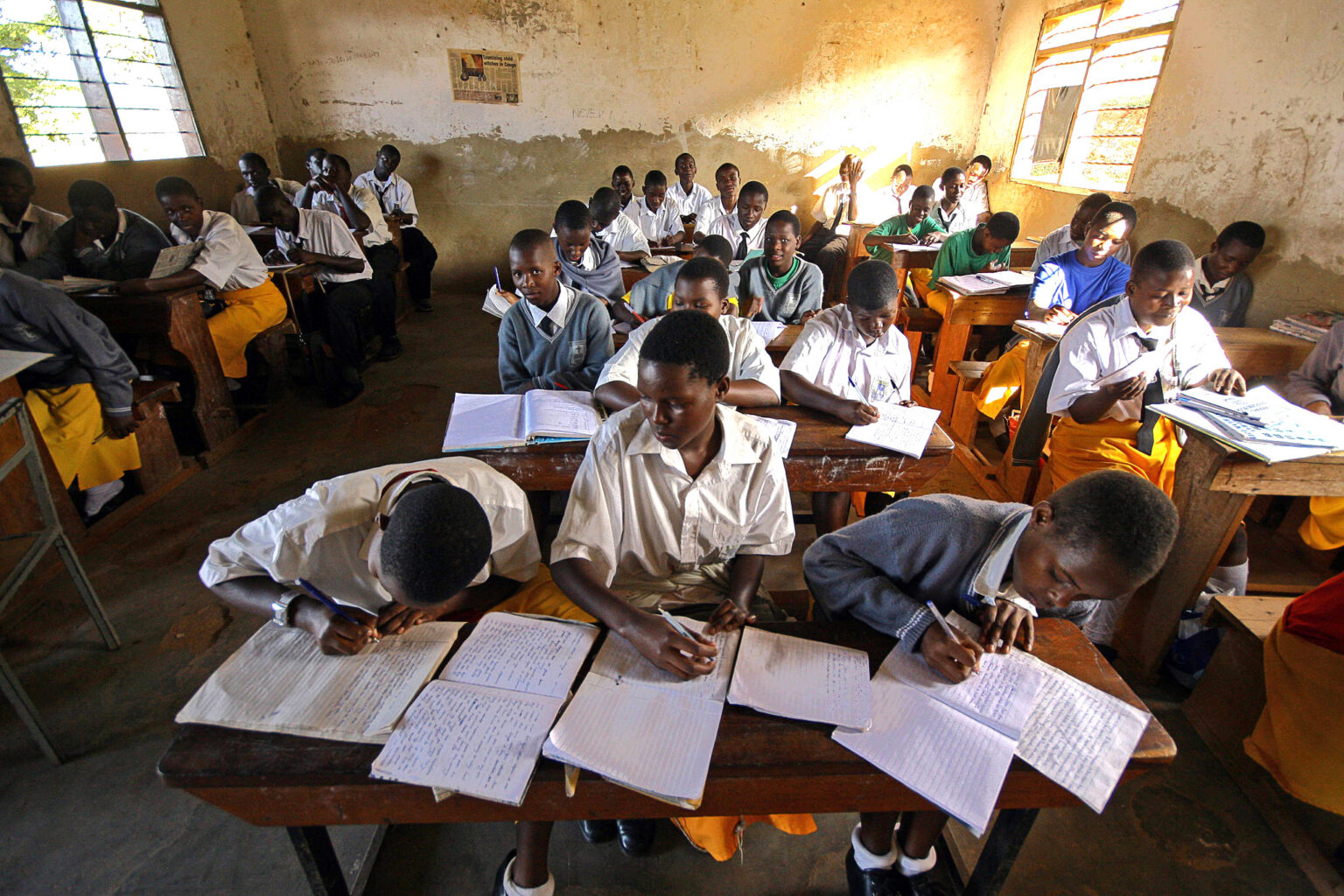
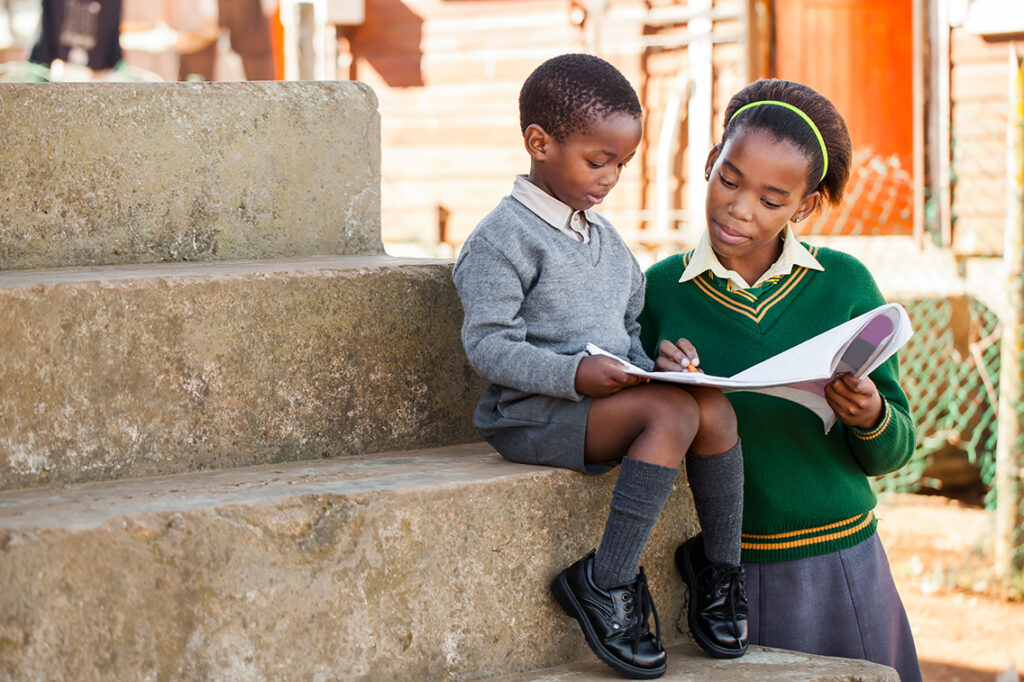
Pupils at Saint Denis Ssebugwawo Secondary School in the Kampala suburb of Ggaba take notes 23 March 2007. The Ugandan government has recently launched the Universal Secondary Education (USE) program, enabling children at certain schools to attend the first year of secondary education free of school fees, with the initiative designed to provide further free […]
Share
It is generally agreed that spending on education can produce a virtuous circle for development, yet not so much corporate social responsibility is devoted to the sector. Stephen Williams spoke to Vikas Pota, CEO of GEMS foundation to find out why.
Last month, when the economic consulting firm EPG conducted research amongst the top companies in the US and UK, it found that over $15bn is being spent on corporate social responsibility (CSR), but spending on health far outstrips that on education.
The value and needs of Africa’s educational sector suggest far more needs to be done to underpin teacher training programmes, and improve the status of the teaching profession across the continent.
Business Backs Education is a special global campaign group. The former US President Bill Clinton, together with Co-Chairs Jim Hagemann-Snabe, CEO of SAP and Majid Jafar, CEO of Crescent Petroleum, launched the campaign at the Global Education & Skills Forum in March 2014. Unesco, the Varkey Gems Foundation, and Dubai Cares lead the campaign under the auspices of the Global Education and Skills Forum.
VIKAS POTA, CEO OF THE GEMS FOUNDATION
It is seeking to raise the proportion of CSR spending by companies that is going on education from its current less than 10% level to 20% or more.
That is quite a tough ask as the number of business bosses that see CSR as lacking a business focus seems to be declining, and those that do subscribe to CSR fundamentals use in-kind donations, rather than cash.
However, Varkey Gems Foundation has launched a low-cost teacher training programme in East Africa, backed by a $25,000 donation from Standard Chartered Bank (Ug). By May of last year, more than 100 head teachers had been trained in improved classroom practices and 1,180 teachers had also been trained. The initial intake of head teachers then passed on their skills to 500 of their peers while the teachers also cascaded their knowledge down to their students.
This is, however, just a drop in the ocean as Varkey GEMS Foundation has estimated that as many as seven million newly trained teachers are required almost immediately in the developing world. But if there is any hope to be had, then it is in this “cascade” training model that we must pin our hopes.
Irina Bokova, the head of Unesco, which is partnering the Business Backs Education initiative, has said that, according to its EFA Global Monitoring Report, there is an annual funding gap of $26bn to achieve basic education for all children in low-income countries.
What are the main challenges you see in the education sector in Africa?
In Africa you have a big challenge in the quality of teachers. We all agree, I think, that teachers are front and centre of any education system. Varki GEMS Foundation is committed to making sure that it impacts the lives of the underprivileged by providing a focus on education. So, we are committed to programmes for the training of teachers in Africa and the developing world. We have in the past year trained 7,500 teachers in Uganda and we are shortly to embark on a huge programme in Ghana as well as other countries in sub-Saharan Africa.
Teachers actually have a lot of motivation and they are there for the right reasons, but the framework to support them is sometimes lacking. So, for example, you have critical issues about teacher’s pay and a teacher’s status. You have the general regard for teachers, and professional development. All these issues have a big impact when it comes to looking at educational outcomes and, therefore, I see one of the big areas to be around the quality of teachers in schools in Africa.
How are you going to meet these challenges?
We as a foundation have been training teachers for the last year and a half in Uganda.And what started off as a private, a nonprofit company, is now in alliance with the government and with other NGOs. We’ve created a community of professional development that teachers can actually learn from and excel in beyond just the courses that we develop, and likewise we’re looking to replicate and build on this model in other countries in Africa which I think is quite critical.
I understand the model is to train teachers to train other teachers?
That’s right. We have what is termed a cascading training system and what happens there is that we provide a lot of support for the cascade to work.In fact, a lot of energy and effort goes into making sure that leakages from the cascade are minimised as far as possible.
So, we find that the impact of our programme is not just on the master trainer or not just the 10 teachers that that master trainer will train, but that those ten trainees will reach further teachers so as to have an impact. And it’s only with the lifetime of a teacher that you see huge benefit. So, by training [500 or] 1,000 teachers, for example, the impact will not just be on the 500 or 1,000 students but 500,000 students over the 50 years that might be a teacher’s lifespan.
Do you issue qualifications to these teachers?
No, not exactly. But our training programmes are all approved by the education ministries. Our parent organisation is an education company that runs schools, and we are spreading the intellectual property of the company in terms of its professional development to make sure people in the public sector are equally as good, competent and effective in the classroom as in the private sector.
Do you see the public sector as having the primary responsibility for the education of young citizens, or is it more the private sector that should take the lead?
No, no. We believe in public-private partnerships (PPPs) as a medium to overcome this crisis in education, this learning crisis. What we want to create is greater dialogue regarding how you mitigate the risks of bad PPPs to make sure that the PPPs that we engage in and promote are very effective in what they do.
We run the Global Education and Skills Forum, which takes place in Dubai in March each year, where some 30 to 40 education ministers come. The African ministers in particular frankly admit that they can’t do it just by themselves. There are not enough resources, not enough knowhow, so it’s a matter of partnership with the private sector as well as the voluntary sector to make sure that the child’s needs are the focus and the quality of education remains paramount.
From where does the GEMS Foundation receive its funding?
Right now we are dependent on the funds provided by GEMS Education, the parent company of the GEMS Foundation, but going forward we are looking for partnerships, because we believe in collaboration, not necessarily just for money, but also the technical knowhow and the expertise and what the private sector can bring to the table. And local knowhow is also quite important.
What sort of sums of money are we looking at, what is your budget?
Actually, we have a very low-cost teaching training programme where it costs anywhere between $100 and $150 in Uganda to train a teacher. It’s a very short modular programme, where the training of a master trainer takes a week, and then that master trainer goes into schools and helps them with training of other teachers there to make them more student-centric. That is because often what happens is a teacher stands in front of the classroom, in a method that is called “chalk and talk”; but we want to actually equip them to move on from that style, because every student is a gem in a sense, and you must cater to every single child in the classroom. That’s what our programme in Uganda has done, and that is what we want to do elsewhere.
You have talked about corporate responsibility programmes reaching a target of 20% going towards education. Is that a global or African target?
It’s a global target. There’s no single benchmark yet, but the reason we chose 20% was that the UN system actually stipulates that 20% of a country’s ODA should go towards education; so that’s why we chose 20% for the private sector as well.
Is there not a case that healthcare and education have certain synergies, for example in ensuring that children receive adequate nutrition with a meal at school; in the delivery of drugs to combat neglected tropical diseases; or simply to ensure that girls of school age reaching puberty have the support to enable them to continue schooling when they begin menstruating. Is there not plenty of synergy between healthcare and education?
I totally agree with you. I think you are absolutely right on this. As I have said, I think and we think that education is at the heart of everything, whether you’re speaking about famine, whether you’re thinking about HIV/Aids, whether you’re thinking about climate change, whether you’re thinking about war and peace; an educated population will help us resolve most of these issues and become more engaged in the discussion. It’s not that we’re saying “spend on education instead of healthcare”. Actually, a lot of the companies that are backing our campaign are healthcare companies and pharmaceutical companies. All these companies already have a lot of healthcare involvement, and education investment can only complement this.
What are the barriers that stop the private sector actually investing more in the education sector?
The challenge that you face is actually that the private sector and the public sector rarely sit at the same table. When it comes to speaking about the global learning crisis and the education challenge, what we try to do through the global education is first of all, create this atmosphere of trust and build respect between the parties, who can together think about ultimately putting the student at the heart of everything; and don’t forget the mechanics, forget the ideology, just make sure that they get the outcome that they deserve – so that’s what the global education actually is.
I go to conferences around the world where you speak about economic prosperity but the education ministry is not present. I go to many education conferences and you speak about the funding. You speak about innovation.You talk about wanting more entrepreneurship in education, but you never have an entrepreneur at the table.
It’s about actually marrying together all these stakeholders to make sure that a dialogue can be started. I would rather prefer a lot more dialogue than accusations across a table. So, that’s what our Forum tries to overcome and we’ve actually seen some very positive results because of this. We see education ministers walk away with a better understanding of what the private sector wants.
Can you tell us something about the Global Teacher Prize?
Let me begin at the beginning. We embarked on a study of teacher status around the world and surveyed 21 countries. We collected half a million data points with regards to what the general public thinks about the teaching profession and teachers. What we found was that only in China are teachers regarded as having the same status as doctors, and that worried us. If we believe that the teacher is the be-all and end-all of education systems, we ought to be doing more to invest in teachers.
One of those things teachers tell us is they simply want professional recognition. They want the spotlight on them, which is only human nature, but they don’t get it. Today, if you look at popular culture you’ll see TV programmes about almost every other profession, whether it’s doctors or lawyers – but seldom do you see programmes about teachers and excellence in classrooms.
So, to celebrate the teaching profession is why we established the global teacher prize, where for the first time ever we are awarding one single teacher with a cash sum of $1m to bring the focus and the spotlight on the teaching profession. By doing so, we’ve showcased thousands of stories of teaching excellence that exist. In fact, I encourage everyone to engage in this prize because I think it’s as critical, if not more critical, than the Nobel Peace Prize or any other prize when it comes to education.
Do you think perhaps there’s a mismatch between the education syllabuses in Africa and the needs of African economies?
I’ve just come back from a trip to South Africa and met with all my South African friends who are captains of industry; they all speak about the skills gap. All of them speak about how unemployment is a massive issue [and] employability. So, when you have businesses that employ thousands and thousands of people tell me that they can’t find young people or talent to fill jobs that exist, there is obviously a mismatch between what’s happening in school and what industry requires.
So how do we tackle this problem?
I think national systems need to evolve the thinking as to what technical education looks like. I don’t think you have to make a case.Government knows that already, but the challenge requires all the stakeholders in the education system to agree with that view. So, for example, the cornerstone of the education system is the teacher. Right now the teacher is so under-invested in that they can’t deliver the core syllabus as they are meant to, and then to ask them to put in place 21st century skills on top of that, or technical innovations on top of that, it’s not that they don’t want to do it, it is simply that they are not equipped to do it.
“Teaching skills in schools” is such a great catchphrase, but what you need to do is invest in teachers and infrastructure to make sure that you can deliver this, to ensure teachers have the experience and expertise to deliver this.