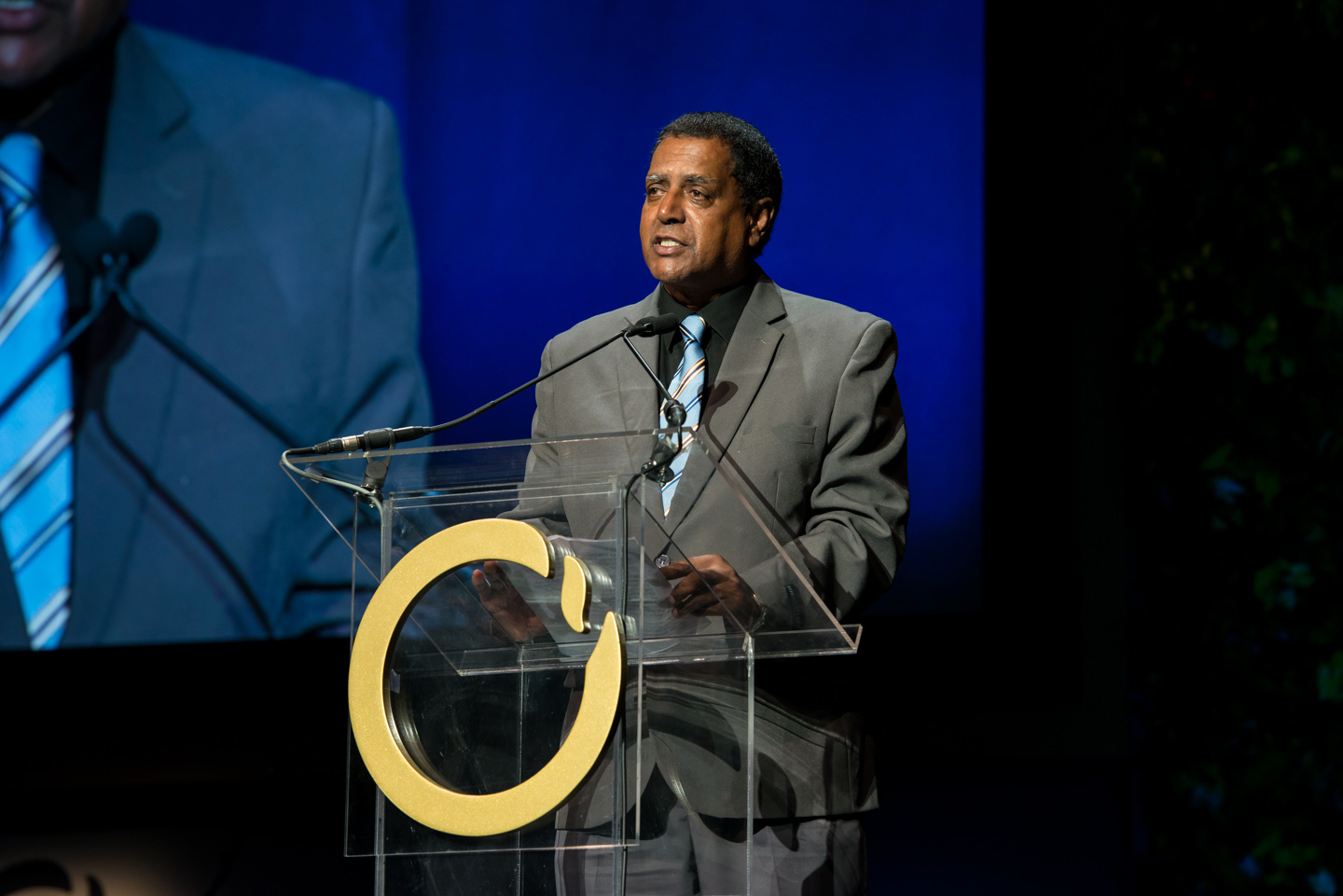
The Goldman Environmental Foundation Awards honoured environmental heroes from each of the world’s six inhabited continental regions with individual cash prizes of $175,000.This year, the prize for Africa went to Desmond D’Sa, an environment activist from Durban, South Africa. Stephen Williams went to meet him.
Almost 70% of South Africa’s industry is located in south Durban, home to more than 300 industrial-scale facilities such as oil and gas refineries, paper mills, and agrochemical plants. It is also home to 300,000 residents, mostly low-income and working-class people who were forcibly relocated there by the apartheid regime to create a cheap labour pool for the emerging industrial economy.
They bear the brunt of industry’s toxic chemicals, leading to the basin’s infamous label of “cancer valley” – a reference to the area’s high rates of cancer, along with unusually prevalent cases of asthma and bronchitis.
Desmond D’Sa was amongst those residents that were forcibly moved to “cancer valley” with the apartheid government’s enactment of the separation act (what they termed the Group Areas Act) in 1969. Just 15 years old at the time, D’Sa recalls his family being moved from “a house with ten rooms, fresh running water and gardens to a four-bedroomed apartment. Because of my looks and my colour I was classified as a Cape Coloured.
“Some of my sisters went to one area; my cousins went to other areas, townships. I found that we couldn’t plant any vegetables in the projects.”
Barely a decade after this enforced move, tragedy struck the family when his father died in 1980. D’Sa is fairly sure that it was the environmental pollution of south Durban that caused his father to fall ill.
“Today, we’ve got 14 of the most modern monitoring stations in South Africa measuring air quality, set up in Durban,” D’sa explains. But, even if pollution levels are monitored, there is still a lack of political will to clean up the environment.
“More than half the population of south Durban has got asthma and we are told that leukemia in south Durban, which is very rife in children, is now 24 times the national rate,” D’Sa says. “There is a lack of political will to tackle these problems,” he insists.
D’Sa also cites the high levels of other cancers, such as of the stomach and brain, and believes that this could be because people have been working for years in the refineries and been exposed to hydroflouride among other toxic chemicals.
He is particularly critical of South Africa’s environmental regulations that, for example, allow the levels of benzene in the environment to far exceed the levels permitted in Europe or the US.
In fact D’Sa knows first-hand the environmental risks associated with working in the refineries as he had a job in them before he left to become a full-time environmental activist, leading grassroots action groups against industrial pollution.
In the 1990s, during a protest outside the ExxonMobil refinery, he was to meet President Nelson Mandela. “Madiba agreed to meet with us and asked what we wanted. At his home we met on Friday, then on Sunday and again on Monday and he summoned all his cabinet from Cape Town to Durban to hear what we had to say,” D’Sa remembers.
But similar efforts to engage the present administration have been less successful. He has met with President Jacob Zuma, but the meeting lasted just a few minutes and no action has been forthcoming.
Now, D’Sa is mounting a campaign to try to halt the proposed expansion of Durban port, a measure that he believes is wholly unnecessary and will only add to the existing environmental damage to south Durban. And, ironically, many of those moved into the area under apartheid, or their descendants, will again be uprooted by the development.
But D’Sa is greatly heartened by the Goldman Prize, the attention it is bringing to his work as an environmentalist, and the prize’s financial resource to continue his struggle.