To reduce the relatively high incidence of drowning in Ghana, a community worker set up a system of lifeguards on public beaches. Then he found himself fighting an attack from an unexpected quarter – local and international lifeguard organisations. David Wood reports.
Ten years ago, Felix Uzor was relaxing by the beach in Accra, Ghana when he heard piercing screams – cries for help that have shaped his life ever since. In a hotel pool nearby, a child was drowning.
Uzor ran to the commotion but he was too late. Not one person crowding around the pool had known how to save the child. “When I got there,” Uzor recalls solemnly, “I saw a child less than three years old, his lifeless body floating on the top of the water.”
Uzor had been working on plans to open a professional sports school in Ghana. Born in Nigeria, he had just moved to Accra after a long stint in London, where he had obtained a sports science degree and lifesaving qualifications.
But the toddler’s death – in a pool surrounded by adults – hardened his resolve to tackle Ghana’s terrifying problem with drowning. Uzor subsequently committed 10% of his sport and fitness academy’s profits to a water safety charity, the Felix Foundation, of which he remains the director.
“I decided that I never wanted to see such a thing happen again,” Uzor says.
With Ghana’s heavily populated coastline and many rivers, it may seem strange that so few Ghanaians know how to swim. But harrowing scenes like the one that Uzor witnessed play out with alarming regularity. The government does not have reliable figures, but the Global Burden of Disease Study sets the national drowning rate at three per 100,000 people. This almost triples the same statistic for Australia, which has a coastline over 100 times longer than Ghana’s.
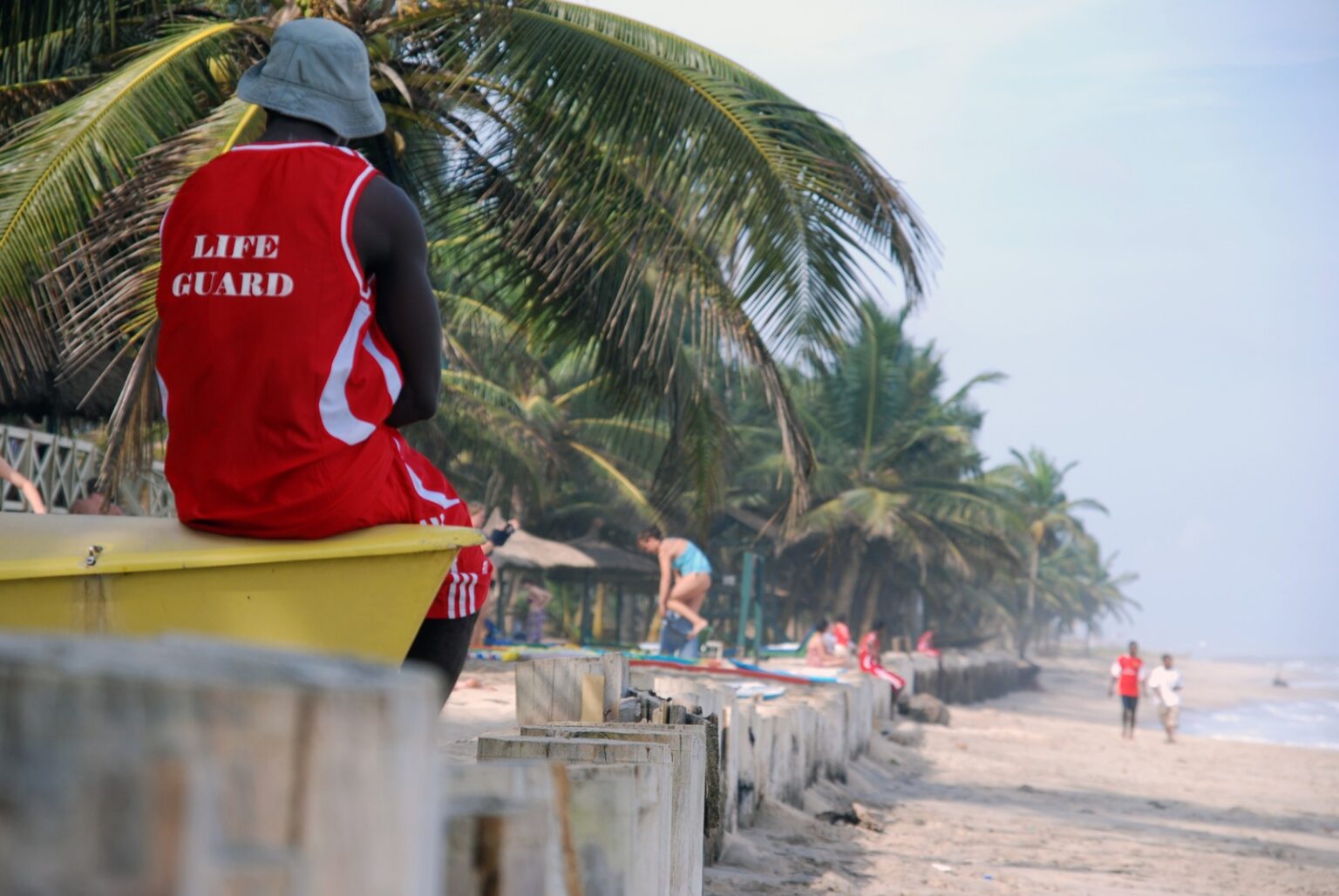
Uzor set out to tackle Ghana’s drowning rate by establishing the nation’s first regular deployment of beach lifeguards. In November 2016, the Felix Foundation coordinated the formation of the Ghana National Aquatic Rescue Unit (GNARU), whose volunteer lifeguards now patrol beaches in Greater Accra on every public holiday – a particularly dangerous time for death at sea.
Despite having an early impact on the drowning rate, GNARU has recently come under threat from an unlikely source – other lifeguards.
The International Life Saving Federation (ILS) and its Ghanaian member organisation waged a surprisingly bitter campaign against the GNARU project, claiming that Uzor cannot train lifeguards without ILS approval. Their public accusations caused the government to place funding for Uzor to train more lifeguards on hold temporarily. ILS has now allegedly threatened a community programme for water safety in Sudan – again on bureaucratic, territorial grounds. Activists fear that these ‘turf wars’ could wreak significant damage on drowning prevention efforts in Africa, where such programmes tend to be vital yet notoriously fragile.
Putting lifeguards on beaches
Uzor started out on the path to founding GNARU three years ago, when he took a self-funded trip to the US to meet with drowning experts. He worked closely with the International Surf Lifesaving Association (ISLA), a non-profit that teaches entry-level ocean rescue techniques in countries without established lifesaving networks.
In November 2016, ISLA dispatched a team of trainers to instruct GNARU’s first-ever cohort. The course participants have worked without pay on public holidays since then, ensuring that GNARU deploys at least 80 lifeguards across seven public beaches.
Nana Blankson, a Ghanaian Navy officer and GNARU’s vice-president, did not take much convincing to enlist as a volunteer lifeguard. “I am already military personnel,” Blankson said, “and if I have to add lifesaving so that people will not die in the water, it is not too much for me.”
GNARU made a noticeable impact on drowning rates in its first year of operation. Government figures indicate that the volunteers have carried out over 20 ocean rescues. No drowning incidents have been reported on beaches patrolled by GNARU. These successes encouraged the government to finance Uzor’s plans for training more lifeguards across Ghana.
“We will be able to cover the beaches from Accra to the border of Côte d’Ivoire,” Blankson said enthusiastically.
The lifeguard war
Late last year, however, the government temporarily placed this funding on hold until GNARU could stave off a bizarre, internecine challenge from within the lifeguarding community.
In November 2017, the Ghana Lifesaving & Diving Association publicly challenged GNARU’s authority to train lifeguards. The Diving Association is the national member of the International Life Saving Federation (ILS), one of several international organisations that issue lifeguard certification.
ILS threw its weight behind the Diving Association’s cause. Harald Vervaecke, ILS’s secretary-general, listed his organisation’s concerns about the GNARU project by email to the author of this article.
The main complaint is that Uzor’s groups have apparently been giving the impression that they are associated with ILS. More generally, Vervaecke insists that GNARU and the Felix Foundation are “not permitted to issue international lifesaving or lifeguarding certificates.”
Uzor denies that GNARU or the Felix Foundation has ever claimed either to be an ILS member or to issue ILS certificates. Rather, he says that GNARU’s volunteers are simply filling a vacuum left by the Diving Association, which has not deployed beach lifeguards since it was formed in 2010.
“The Ghana Lifesaving & Diving Association knew that they were not doing what they were supposed to be doing,” Uzor says. “GNARU is now doing most of the job because [we] are not happy that people are just dying unnecessarily.”
ILS is a membership-based organisation. It does not have the legal authority to regulate non-members like GNARU and the Felix Foundation.
Oddly, Vervaecke also subscribes to a conspiracy theory related to Uzor’s nationality. From his base in Belgium, he claimed by email to the author to have evidence that Uzor has fraudulently listed himself as ‘Ghanaian’ on government forms. Uzor allegedly did so even though – in Vervaecke’s words – “We all know he is not a Ghanaian.”
Uzor, who freely admits to being from Nigeria, is considering suing Vervaecke for defamation. In any event, it remains unclear how Uzor’s nationality might affect his ability to train lifeguards in Ghana.
The Diving Association has been less forthcoming than Vervaecke. A representative declined to comment for this article, instead threatening to report the author to the Ghanaian authorities. More sinisterly, Uzor claims to have received death threats from one of the Diving Association’s members.
NGO overreach?
Now Vervaecke has allegedly set his sights on a grassroots initiative for drowning prevention in Sudan. Dan Graham, the co-founder of the charity Nile Swimmers, says that he received a letter from Vervaecke in December 2017. The letter ordered Graham to stop running lifesaving courses through Nile Swimmers, which it described as a ‘rival organisation’ to ILS.
Nile Swimmers has attracted widespread acclaim since the programme began over a decade ago, receiving support from the Sudanese government and UNICEF. Like GNARU, Nile Swimmers is not an ILS member and – according to Graham – has never claimed to be.
“(ILS) are attempting to undermine community-led projects,” says Graham.
In Graham’s view, Vervaecke’s insistence that various water safety programmes be run through a local ILS member is not appropriate for tackling a public health challenge like drowning.
“There is a desperate need for a global drowning prevention alliance that welcomes all organisations who are contributing towards reducing the burden of drowning.”
Back in Ghana, Uzor has recently convinced the government to dismiss the ILS’s complaints and press on with funding more training courses for lifeguards. As he emerges from a turbulent few months, Uzor remains resolutely focused on his ultimate mission.
“Nothing will stop me from saving life – especially the lives of children – around water bodies.”
One wonders if some of the players in this sad episode have lost the plot and have been trying to throw out the baby with the bathwater? NA