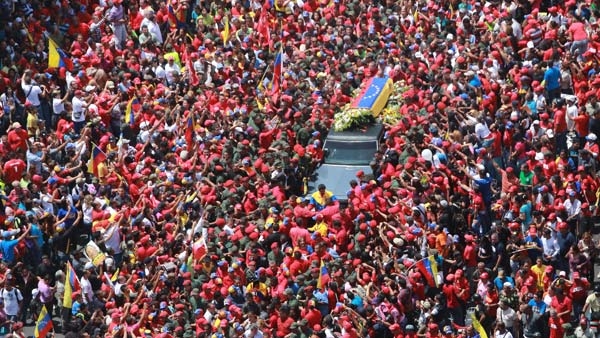
The death of President Hugo Chavez on 5 March, after a long battle with cancer, sparked a wave of mourning, not just across Latin America but Africa as well. Charles Hayward explores his significance for Africans.
When President Hugo Chavez was first elected in 1998, Venezuela was a uniquely stratified society. The country was run by a white oligarchy, and the vast majority of the country’s wealth lay in the hands of a tiny minority. Chavez, on the other hand, was voted in by the disenfranchised poor and a section of the disenchanted white middle class, whose standard of living had decreased over the previous decade.
Of African, Amerindian and Spanish ancestry, Chavez’s enduring popularity was in part due to his racial origins. The mestizo – or mixed people of black, Indian and white background, comprising 67% of the population – saw him as a fit representative of their cause, and his ability to meet their needs saw him voted in four times. Populist social programmes were central to his success. These included slum missions that provided free healthcare and education, together with subsidised food and clothes. He widened the constitution to bring in protections for indigenous people and women.
The brand of “21st century socialism” he espoused – following on from “Bolivarianism”, which combined elements of capitalism and socialism – was never precisely defined, beyond it being about a commitment to liberty, equality, social justice and solidarity, but it aimed to empower the masses through “participatory democracy”. Communal Councils and Bolivarian Circles were intended to give the people input into decision-making and policy-making at the grassroots level.
The funding for Chavez’s programme came from Venezuela’s huge oil wealth, following on from his “re-nationalisation” of the oil industry under the state-run oil company, PDVSA. Venezuela is the world’s fifth largest oil exporter, and oil prices jumped 660% between 1998 and 2008. His African roots informed his vision and international policy on many levels. “One of the greatest motherlands of all is no doubt Africa,” Chavez said in 2005. “Every day we are much more aware of the roots we have.”
He sought to promote policies in OPEC that supported development in less oil-endowed countries. He had begun to promote South-South co-operation through involvement in the Africa-South America Summits, a newly developing partnership aimed at advancing common interests.
Chavez provided solidarity support to African disapora communities in Haiti and the US, and helped other African countries and causes.
Plaudits for Chavez have flowed in from across Africa since his death. A common theme has been acknowledging his commitment to improving the position of the weakest and most vulnerable in society. South Africa’s president, Jacob Zuma, described him as a “visionary leader committed to the social struggles of the less fortunate”, while Nigeria’s Goodluck Jonathan commended his efforts to improve the living conditions of the underprivileged.
The statistics say that poverty in Venezuela under Chavez was reduced by 50% and extreme poverty by 70%; that infant mortality decreased by a third; and unemployment halved.
Chavez was lambasted in the Western media throughout his time in power, and by the Venezuelan media – controlled by the opposition – and yet to many Africans, he is an icon for building a nation with a distinct national agenda, resisting Western imperatives in the process.
Some have commented on this. Zimbabwe’s Zanu PF party has expressed the hope that Chavez’s successor “would continue the revolution against the forces of imperialism”. Julius Malema, the former president of the ANC Youth League, has lauded him as “a true symbol of anti-imperialist struggles in Venezuela, Latin America and the whole world”.
The former Ghanaian president, Jerry Rawlings, has observed however that there is a relative lack of acknowledgement of his achievements by African leaders, lamenting the “failure of African leaders to show open sympathy”, and wondering “if they were frightened of Western reprimands if they took decisions to openly commiserate with the Venezuelan people”. He would have liked to see flags flying at half-mast across Africa in honour of the fallen Chavez. Should Chavez’s handpicked heir, Acting President Nicolas Maduro, win the presidential elections in April, he has large shoes to fill.