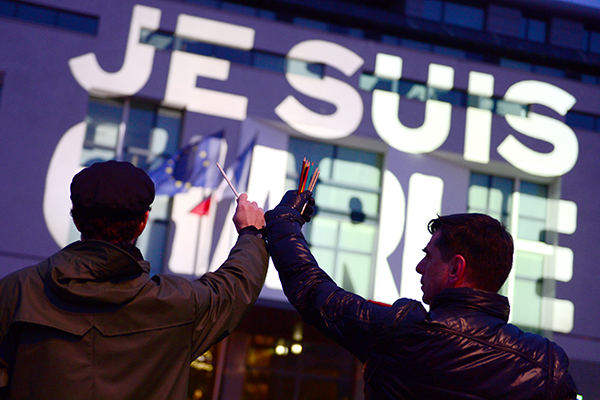
For anyone who participated in the Je Suis Charlie Paris anti-terrorism march on 11 January, four days after the killings at Charlie Hebdo, this article might well disturb the collective feelings of self-righteousness and celebration of French and European “values” that underscored that march of solidarity, writes Dr Nora Kamala Wittmann.
Like everyone else, I was shocked and deeply impacted by the tragedy that manifested in Paris, where I once lived studying social and cultural anthropology and international law. But there is another reason for my deep distress.
While I join millions of people worldwide in objecting to the killing of any journalist, cartoonist, police officer or civilians, my most profound sadness comes from the unfolding reaction and drama that ensued after the massacres, when leaders from both the left and right wings of the political spectrum worldwide (some of whom should be standing before the International Criminal Court) began to incessantly foam at the mouth with self-righteousness and parade themselves as defenders of liberty and good “values”.
It fills me with sadness, that amid all the grief and drama that has unfolded since last month’s violent deaths, what the media is failing or choosing not to depict or grasp, is the obvious connection with France’s age-old history as coloniser and oppressor.
Sadly, France and the victims have paid the ultimate price at the hands of the children from the very nations that France has systematically and continuously oppressed and exploited for
years.
This connection to the events should not and cannot simply be dismissed.
History has on many occasions demonstrated that violence by the oppressed – engendered by systematic violence against them – is often not directed back against the actual source of the problem, but finds expression in contradictory terms that will not necessarily have any emancipatory or progressive potential. In one of his writings, Frantz Fanon brilliantly analyses this phenomenon.
For decades, France has brutally suppressed liberation movements in both North and sub-Saharan Africa, and has eliminated all leaders who showed courage and pursued emancipatory politics for their people. Burkina Faso, Algeria, Mali, Côte d’Ivoire and Cameroon are some examples. After what has happened in Paris, it would be irresponsible for any leading French and international politicians to negate this elementary connection and simply portray the Charlie Hebdo terrorists and the hostage taker as just mad and evil individuals.
Religion aside, there is ingrained denial in the Western political class, on how the history of oppression and colonialism and their own responsibility in perpetuating that, gives birth to the likes of Amedy Coulibaly and the Kouachi brothers.
Hostage taker and killer Coulibaly, for example, reportedly told one of his hostages: “It is you who vote in your governments and your governments have never hidden from you that they will go to war in Mali or elsewhere… It is you who finance them. You pay taxes to them, and (that means) you agree (with them)”.
Without endorsing Coulibaly’s actions, his reasoning and reference to his homeland – Mali – is pregnant with further meaning. It is undeniable how Western taxpayer’s money has on many occasions helped finance neo-colonial wars that have hurt and killed many Africans in their thousands. (Although arguably the recent French intervention in Mali might have had a more positive than negative outcome, given the fact that Islamists were not only slaughtering Malians, they were also destroying world heritage sites and ancient libraries.)
I am deeply grieved for the lives lost in Paris terrorist attacks, but I am also deeply grieved for the millions of people of Algeria and Mali, that France colonised and brutalised, killed over centuries, a history without which the Kouachi brothers and Coulibaly would not have come to live at the low end of the social stratum in France.
Just as I feel deeply sad for the people of Guadeloupe, Guiana and Martinique, where the national liberation movements were brutally crushed by France, after centuries of genocidal enslavement, without which the young policewoman (from Martinique) who was killed by one of the terrorists would not have been in the wrong place at the wrong moment. These are facts that cannot be dismissed. There are more links threaded in the long relationship between the oppressor and the oppressed, many of whom have left in search of better lives in the land of the oppressor after the latter has left trails of destructions in the oppressed people’s motherland.
So in my view, together with other means of combating terror globally short-term, long-term, the only way that France and other European and “Western” nations will be able to prevent more terrorist violence being perpetrated on their own soil in the future, is by finally proceeding to reparations for their age-long genocides and crimes against humanity, as is also their clear obligation under international law.
One such form of reparations in international law, is that of cessation – meaning, that Western nations have to desist from and cease continuing to rob African countries of their natural resources, brutalising their people and sabotaging their sovereignty.
One of the reasons why Western powers can play world police today (while expanding and protecting further their own economic power and geopolitical interests) is because for centuries they have used their own form of state terrorism, which today they camouflaged as “humanitarian interventions”, to continue to plunder Africa.
Stopping further plunder and making reparations to Africa would go a long way in finding peace for all.
Dr Nora Wittmann is an international lawyer, social anthropologist and author of “Slavery Reparations Time Is Now: Exposing Lies, Claiming Justice for Global Survival – An International Legal Assessment” and co-author of the children’s book “Little Afeni and the Cause for Reparations”.