International headlines have ceaseless blared about the terrible scourge engulfing America at the moment – brutality and murder of innocent black Americans at the hands of White police officers. Our US correspondent Leslie Gordon Goffe, joins the global voices asking: What is going on in Barack Obama’s post-racial America?
For many black Americans, the election of their first black president signalled an end to the bad, old racist days and a beginning of the good, new tolerant society. But alas, 6 years on, black people’s lives – especially the lives of young black men in America – are as little valued and are as likely to end at the barrel of a white policeman’s gun in Obama’s America as they were before him.
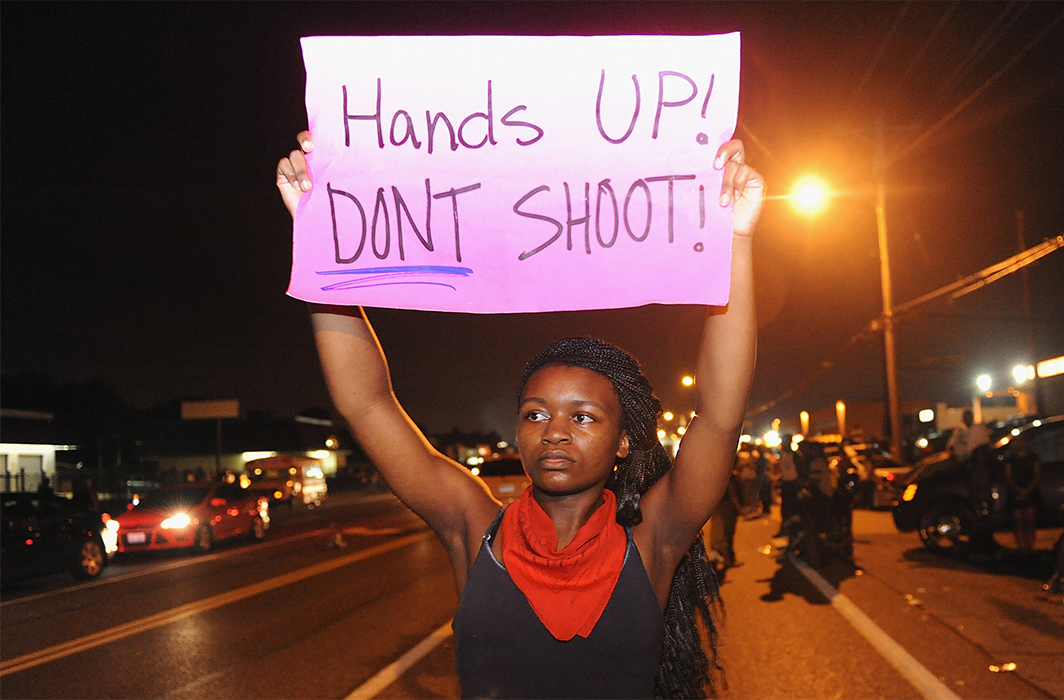
Michael Brown, at just 18 years old, died at the barrel of a white policeman’s gun in Ferguson, Missouri, on 9 August, igniting world-wide anger and protestations, more so in the US itself. Michael was shot 11 times – twice in the head and 9 times in the chest while he had his hands up to indicate he was unarmed.
On his way to his grandmother’s house, “Mike-Mike”, the name his family called him, was set upon by a white policeman who emptied his gun into the young man because he was jay-walking – that is, walking in the street instead of on the pavement.
Enraged, Ferguson’s residents took to the streets in protest at what they saw as a modern-day lynching by a police force paid to protect and serve them, but which more often brutalises and kills them.
For John Crawford, too, death came at the end of the barrel of a white policeman’s gun. On 5 August, four days before Michael Brown’s killing in Ferguson, the 22-year-old Crawford was shot and killed by two white policemen in a department store in Beavercreek, Ohio, while inspecting a toy pellet gun he was interested in buying.
The policemen, who were involved in a similar shooting four years before, claimed Crawford had threatened shoppers with the toy weapon and that they shot him only after he refused to drop the pellet gun, which they claimed they believed was a real gun.
“He looked as though he was going to go violently,” one of the policemen who killed John Crawford said in the local press. But a video recording revealed that Crawford was shot without warning and that he was talking on a cell phone to his family, who say they heard when he was gunned down by the police and when he took his last breath.
“He was a good son and a good father to his two children,” John Crawford’s father said of his dead son.
Like John Crawford and Michael Brown, Eric Garner was also killed by a white policeman. But Garner did not die at the end of the barrel of a gun. He died an even more primitive and brutal death.
The sickly, overweight, 43-year-old asthmatic, who also suffered from diabetes, died after being wrestled to the ground in a New York street by a gang of white policemen, one of whom locked his arm around Garner’s neck in a deadly choke-hold.
The choke-hold, which is banned by the NYPD, crushed Garner’s windpipe, stopped his breathing, and killed the husband and father of six.
“I can’t breathe!” Eric Garner, who was selling untaxed, loose cigarettes on a street corner, pleaded over and again to the 5 white policemen pinning him to the ground, in a phone-recorded video which was widely circulated online for the entire world to view how he met his brutal death at the hands of those who were meant to protect him.
The “I can’t breathe!” protest that would later engulf New York City, will be remembered as one of the defining moments of police brutality against black people under the black presidency of Barack Obama.
It is not an exaggeration to concur with those who believe that black men in America are an endangered species, hunted like wild animals in a blood sport, to the extent that hundreds of rap protest songs about police brutality are now in high demand.
Some favourites on many stations include: Crooked Officer by The Geto Boys and F*** Tha Police by NWA. “Police think they have the authority to kill a minority,” one of the lyrics in the NWA song says.
It is a long and strongly held view among black Americans that each year a lot of black people are killed by white people in deaths that are not tabulated.
Activists reckon at least 300 African-Americans are killed unlawfully by police each year, but the FBI insists the number is closer to 100 and none all these were, the FBI claims, “justified homicides”, people who presented a real and present danger.
Police shootings are rarely ever classified as “unjustified”, no matter how clear their guilt is. The Chicago Police Department admitted to only one such unlawful or unjustified killing in almost 15 years, but would not give details to the black Internet newspaper Colorlines, which had been investigating police deaths. Colorlines found, too, that cops implicated in unlawful killings had usually killed many times before.
More than half of the Chicago policemen named in wrongful death suits had, Colorlines found, multiple lawsuits against them. Despite their record, few were disciplined or punished in any way by the police department. “The suspect pointed a gun.” “The suspect lunged” are the familiar excuses offered by the police after they have been involved in a shooting. “I felt threatened.”
Ironically, a white policeman has more reason to feel threatened and at risk, the evidence shows, from another white man than a black man. After all, the US Bureau of Statistics shows that whites commit many more crimes than do blacks. They commit 60 per cent of the most serious crimes and are more likely to have drugs or weapons on them when stopped and searched by police.
But despite all this, blacks are arrested more often than whites and, according to the advocacy group The Sentencing Project, blacks are likely, once found guilty, to serve longer sentences than whites for the same crimes.
To get to the bottom of all this, the Malcolm X Grassroots Movement, an advocacy group with offices in black communities across the US, decided to do its own report on fatal police shootings of African- Americans.
In its exhaustive, 130-page study, Operation Ghetto Storm, which looks at killings in the year 2012, the Malcolm X Movement found there was a “war against black people” and that a black person had been “executed” every 28 hours in 2012 by police, and by security guards and vigilantes associated with the police.
It’s a bleak picture for black men in the United States. If they don’t manage, somehow, to die at the end of the barrel of a white policeman’s gun, black men can look forward to being hounded by the police from the cradle to the grave.
“There is a crisis of perception where African-American males and females take their lives in their hands just walking out the door,” said Delores Jones-Brown, of the Center on Race, Crime and Justice at John Jay College in New York. A chief culprit in all this is the American media, which happily perpetuates vile, racist stereotypes, developed during slavery, of bloodthirsty black men causing bedlam.
Interestingly, The Huffington Post, an Internet newspaper, found that even when blacks are the victims of crime and whites are the perpetrators, media coverage adopts a sympathetic tone toward the white criminal and a sceptical one toward the black victim.
The Huffington Post pointed to the case of Eric Bellucci, a white man alleged to have butchered his parents in New York in 2010. Son in Staten Island murders was brilliant, athletic – ran one sympathetic headline. But his demons were the death of his parents.
By contrast, coverage of Trayvon Martin, a young black man who was shot and killed in Florida in 2012 on his way home, was very, very different. The NBC TV programme pointed out, for some reason, that Trayvon Martin was suspended three times from school. This, the Huffington Post said, showed how race colours everything in America.
“I think we disproportionately stop whites too much,” said Bloomberg provocatively in an interview, “and minorities too little.”
“Whereas Belluci, a white suspected murderer, had his best traits displayed by the headline,” wrote The Huffington Post, “Martin, a black shooting victim, was noted for his disciplinary issues at school.”
But despite such damning evidence, many whites, like conservative talk show host Michael Medved, insist America’s media, its justice system and its police are not racist. “A black person is more likely to die at the hands of a black person, than by the gun of a white policeman,” he claimed on his talk show after the Michael Brown shooting in Ferguson. “If you defer and don’t try to challenge a police officer, he may insult you but he won’t kill you.”
Tell that nonsense to Amadou Diallo, the Guinean immigrant shot 42 times by four white policemen in the doorway of his home in New York City in 1999. Tell that nonsense to Sean Bell, who died in a barrage of 50 police bullets in New York on his wedding day in 2006. And tell that nonsense, too, to Eric Garner, whose death at the hands of New York police wasn’t supposed to happen in Barack Obama’s America nor, either, in Mayor Bill de Blasio’s New York City.
Elected in a landslide in 2013, with the overwhelming support of the African-American community, New York City’s new mayor, de Blasio, a white man with a black wife and two mixed race children, had promised to clamp down on out-of-control police and on hated law enforcement practices such as stop-and-frisk, which led to 5 million people, 90% of them black and Latino, being stopped and searched for drugs or guns on the streets of New York City over the past decade.
All this happened while Republican media billionaire Michael Bloomberg was mayor of New York City. He claimed stop-and-frisk had been behind the massive drop in crime in the city, but others point to several other factors.
Challenged over the stop-and-frisk tactic, Bloomberg was unapologetic. “I think we disproportionately stop whites too much,” said Bloomberg provocatively in an interview, “and minorities too little.” Bloomberg’s police chief, too, Raymond Kelly, showed he was not afraid to speak his mind when he said in a public meeting that he hoped the police’s stop-and-frisk tactic instilled “fear in (black and Latinos) every time they leave their home.”
As it turned out, only around 10% of those stopped and frisked were actually arrested and only 2% were found to have weapons on them, usually a white person. To the former mayor’s, and the police chief’s dismay, a New York judge ruled in 2013 that stop-and-frisk, when aimed at blacks and Latinos, was discriminatory and violated the 4th and 14th Amendment of the US Constitution. The judge also ordered major reforms to the NYPD’s use of stop-and-frisk.
For the pain it has caused black New Yorkers, stop-and-frisk has not stopped much crime. Yet, so determined was Mayor Bloomberg to defend the controversial police tactic, he used millions of dollars of his own great wealth to purchase TV commercials discouraging New York City Council from passing legislation making it easier for New Yorkers to sue the police if they felt they had been racially profiled by them. But even Bloomberg’s millions could not stop the anti-stop-and-frisk legislation passing.
And now that Bloomberg has left office, and Bill de Blasio is New York’s new mayor, the city’s black and Latino residents want to know whether de Blasio will keep the promises he made. The evidence so far is mixed. A report by the New York Civil Liberties Union shows the numbers of blacks stopped and frisked has declined only a half a per cent since de Blasio has been in office.
“I haven’t personally seen any change in the officers within the community I live in,” Salema Davis, a director at the George Walker Jr. Community Coalition in New York, told Newsweek magazine. “I really think they need to retrain them on community sensitivity.”
However, while the numbers of blacks and Latinos stopped by police have not yet declined under the new administration, the number of whites stopped and frisked in New York has risen considerably, by 3%. There’s also a chance that Mayor de Blasio might convince the NYPD to have its officers wear body cameras, which would show just how they are interacting with the people they are meant to protect and serve.
As for protecting and serving in Ferguson, Missouri, the attention the killing of Michael Brown brought to the town has put pressure on whites there. Whites have for years controlled everything in Ferguson, but are now being pressed to give black people a piece of the pie.
Fifty of the town’s 53 police officers are white. Ferguson’s mayor is white and so are all the members of the school board and 5 out of 6 of Ferguson’s city council members, as well. Only one black person has a seat in the governing body of a town that is almost 90 per cent black. These numbers make clear why what happened there happened, and why things have to change!
As to the unlawful, extra judicial killings of African- Americans, some say the rest of America can learn a lesson from Washington DC, which once had the highest rate of police shootings in the country, but has since cuts these numbers through better police training and requiring greater accountability from the police.
But many do not believe the police can be reformed and made to protect and serve, and treat African-Americans humanely. The Malcolm X Movement is not convinced. The organisation recently published the booklet, Let Your Motto Be Resistance: A Handbook on Organizing New Afrikan and Oppressed Communities for Self Defense.
“To honour the memory of every Black man, woman, and child summarily executed at the hands of the police…let us organise our communities to end the terror being waged against us”, said Malcolm X Grassroots Movement member Kali Akuno.
As the adage goes, two wrongs do not make a right. But there’s little doubt the policeman who shot the unarmed Michael Brown 11 times, would think twice about tangling with Robert Charles, a back-to-Africa advocate, who in 1900, fed up with police persecution, picked up a gun and took on the entire New Orleans police force.
When 3 policemen came calling with guns and clubs one night at the home of Robert Charles, a man they considered a political troublemaker, they had no idea by the time it was all over, five of them would be dead, a dozen wounded and Robert Charles, whose lifeless body was burned and mutilated by the police, would be remembered as a hero.
“The white people of this country may charge that he was a desperado” wrote the pioneering black author and newspaper woman Ida Wells-Barnett in a book about Charles, “but to the people of his own race Robert Charles will always be regarded as the ‘Hero of New Orleans.’”
Another black man who became a legend because he stood up to the police is Mark Essex, a one-time member of the militant Black Panther Party for Self-Defense.
Remembered in song and books for what he did in New Orleans in the 1970s, Mark Essex, like Robert Charles, picked up the gun when he tired of police persecution.
In December 1972, Essex sent a letter outlining his grievances to a TV station and went on an anti-police shooting spree that ended with five policemen dead and 13 wounded. The letter Essex sent to the TV station explained how police brutality, and miserable racial abuse when he served in the US military, had set him on his path to bloody revenge.
Let this be a cautionary tale.
The rising white police brutality on innocent black people is an issue that deserves international attention beyond news headlines. International organisations such as Human Rights Watch, Amnesty International and even the United Nations, must dare call an end to the atrocities befalling modern America under its black president.