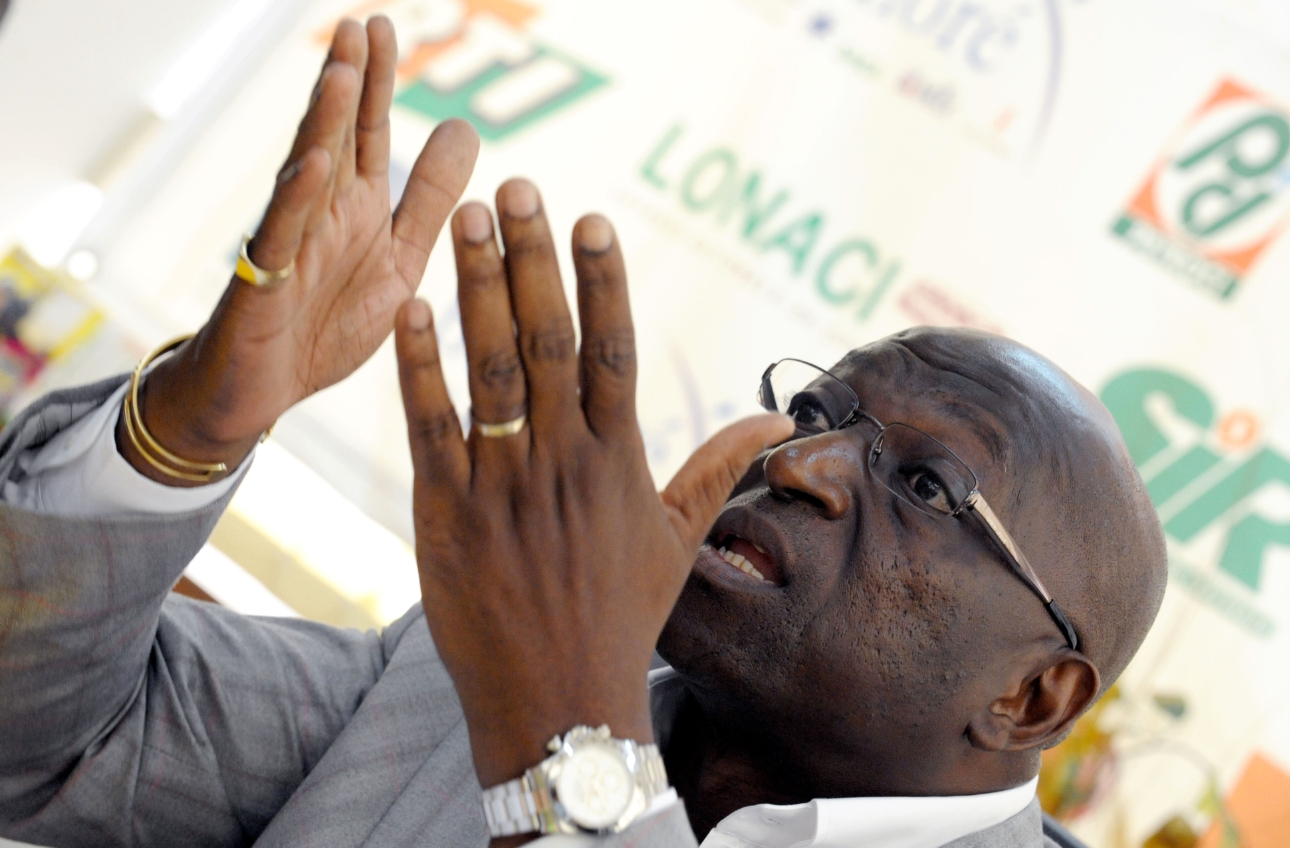
FIFA executive committee member, Jacques Bernard Anouma, insists he will challenge Issa Hayatou for the CAF presidency next March. But what has he really got to offer? Osasu Obayiuwana, our football editor, sat with Anouma, for over two hours, in Abidjan’s Cocody district, to discuss the burning issues affecting African football.
Jacques Bernard Anouma has made it crystal clear that he is after one thing in March 2013, when the African football fraternity assembles in Marrakech, Morocco – the seat the Cameroonian Issa Hayatou has kept extremely warm for the last quarter-century: the presidency of the Confederation of African Football (CAF).
The former financial director in the Ivorian presidency, during the tenure of Laurent Gbagbo (now being tried for crimes against humanity at the International Criminal Court), insists, in this exclusive interview with New African, that the credibility of CAF is badly damaged and requires a change of leadership, in order to regain credibility.
Q: Can you tell the African football public what happened at the CAF executive committee and General Assembly meetings that took place in the Seychelles at the beginning of September?
A: With regards to what happened at the executive committee meeting, they agreed to validate the proposition, made by the Algerian member of the committee [Mohammed Raouraoua], that the eligibility rules for contesting the presidency of CAF be changed.
Twelve out of the 13 voting members of the executive committee voted to support this proposal, which was also carried at the subsequent General Assembly.
Q: The new rule has excluded every national football federation president in Africa from contesting the CAF presidency, except those who are on the CAF executive committee who have voting rights. What are your remarks about this?
A: I was very surprised that the General Assembly voted to support this amendment, as the first victims of the amendment would be themselves, the federation presidents, as they can no longer aspire to become president of CAF. But they might have their reasons for doing so. Some people may have been compelled to do so, for reasons that I will further explain…
Q: Why do you think they voted for an amendment that disenfranchised them?
A: I really can’t explain the reasons why they supported the amendment. In the 21st century, such an undemocratic act should not take place. The executive committee does not have the right to make themselves the only people that can contest the presidency of CAF. But the pressure that people were under, and the other things that I have heard happened, may be responsible for this. Also, calling on the federation presidents to vote publicly, in front of everyone at the General Assembly, made it difficult for people to say no. But I was told that the new law would not affect me and would only be valid for the 2017 elections, and not the March 2013 one…
[Editor’s note – According to Article 21 of the CAF statutes, any amendment to the statutes must take effect 90 days after it has been passed by the General Assembly (or earlier, should the General Assembly so resolve), which means the presidential electoral eligibility amendment will certainly become law this year, on 2 December].
Q: Do you, and your colleagues, realise that you are duty bound to explain your conduct in CAF to the people of this continent, on whose behalf you administer the African game?
A: I do realise the responsibility that I have. But I don’t know if the others realise this. I still do not understand how we could have passed an amendment that is clearly anti-democratic. At the moment, it appears that we are against the progress of African football. We are opening doors for people with money, who want to take over the Confederation. I don’t understand this. One day, we will all have to explain to the African people why we took these decisions.
Q: What do you think is the opinion of the African football public, regarding the behaviour of national federation presidents, the executive committee members of CAF, and particularly, the CAF president, Issa Hayatou?
A: After our recent meeting in the Seychelles, there is no question that we, as a confederation, have emerged with a very bad image. People in Africa have a very bad opinion of CAF. If it were left for the African people to decide, there is no way the current amendment would have been passed. Only 54 people decided the fate of African football. I am sure that if you, as a journalist, carry out a general survey, you will find out that the people of Africa do not agree with what has been done.
Q: It is an open secret that the CAF president has been unwell for a while now. Is it right that someone in his state of health wants to continue in a high-pressured job, such as the CAF presidency?
A: I believe that we should not talk about this subject. If he thinks that he is well enough to contest, that is up to him. We should not go into people’s private life. I prefer to talk about the state of African football. His health will not be a part of my campaign to become the CAF president.
Q: What should be the maximum number of mandates for a CAF president?
A: A maximum of three mandates, which comes to 12 years, of four years each. That should be enough for any president to implement his programme. Whatever he cannot achieve in 12 years, he cannot achieve it, even if he is given more time. The International Olympic Committee has put this in place, and CAF should adopt it.
Q: Lydia Nsekera of Burundi is the first woman to become a member of FIFA’s executive committee, which was a great moment for Africa. But CAF has said nothing about bringing her onto its executive committee. Is that not strange?
A: She was invited onto the CAF executive committee at the last CAF assembly in Seychelles…
[Editor’s note: But at the time of publishing this interview, Lydia Nsekera’s name was not included on the CAF website as a member – whether full or ex-officio – of the CAF executive committee].
Q: After what happened in the Seychelles, what is the future for African football? It appears that the continental game has entered a very mysterious and dark period.
A: After the last General Assembly, the future of African football does look very dark. But I think that it is not too late. I think the forthcoming election, in March 2013, for the presidency of CAF, is a chance to make things right. African football has a future and we must do what is good for it.
We need to make CAF a strong confederation and not give it to people who are only doing what is good for themselves. It is not supposed to be a village or family assembly that is headed by a chief, with everyone following blindly and unable to say “no”, when they need to say “no”.
Q: Why did you invite me to Abidjan to have this conversation?
A: I don’t know you personally but from what you have written, you appear to be someone who says what he thinks, without fearing the consequences. So I thought that people should see me, through what you write.
Q: I will let you have the final word. What else have you got to say?
A: I want to tell the people of Africa to stand up for their rights and say “yes” when they have to say “yes”, and “no” when they have to say “no”. What happened in the Seychelles shows that we have a long way to go, and that CAF must become a democracy and be given back to whom it belongs – the national federations.