A quiet but exciting revolution in surgery has been gaining ground in hospitals in the more advanced nations of the world. Robots, controlled by highly trained operators, have been very effectively carrying out a multitude of operations. Could robot-assisted surgery be the solution Africa has been waiting for in order to be able to deal with the huge current unmet demand? Report by Ken Otuokwe and Anver Versi.
A quiet robotic revolution is occurring in the global health sector and experts predict that its application will increase in the next 5-10 years, particularly in the more developed countries.
Computer-assisted surgery, or robotic surgery, involves partial interference or complete dependency on specially devised machines to carry out surgical procedures. The surgical robotic market is expected to rise from $3bn to $12.6bn by 2025.
However, while, the market is booming, growth is expected to be constrained by the high costs associated with accidental death or injuries caused by broken instruments and system errors. A study conducted by the University of Illinois found that around 144 deaths and more than 1,000 injuries were linked to complications arising from robotic surgery.
Despite this, surgery by robots typically improves efficiency, efficacy and precision during a procedure and minimises post-operation complications. It is finding increasing favour in developed and even developing economies.
In the UK, the use of robotic surgery has increased vastly in NHS hospitals since the first mechanical aids were installed a decade ago. It is used mainly for prostate, bladder, gynaecological and kidney-related operations, and for the removal of tumours.
The Royal Marsden has the largest and most comprehensive programme of robotic surgery for cancer in the UK, so patients travel long distances to be treated here.
“As one of the few centres in the world to offer Transoral Robotic Surgery (TORS) for patients with radio-recurrent and radio-residual cancer in the head and neck, we have devised a new technique for resection of these cancers,” says Professor Vinidh Paleri, Consultant Head and Neck Surgeon at the Royal Marsden.
“Our research has shown that the TORS technique has equivalent long-term oncologic outcomes to open surgery – without the need to split the jaw and perform extensive reconstruction – and I expect this to lead to a new standard of management for this disease,” he adds.
By using surgical robots to remove the mucosal lining of the tongue base, researchers detected more than 50% of tumours that would otherwise have been classified as cancers of unknown primary cause. Being able to identify the primary tumour has implications for treatment planning and outcomes, says Professor Paleri.
This is a revolutionary change in the management of head and neck cancers over the past decade, thanks to the advancement of robotic surgery.
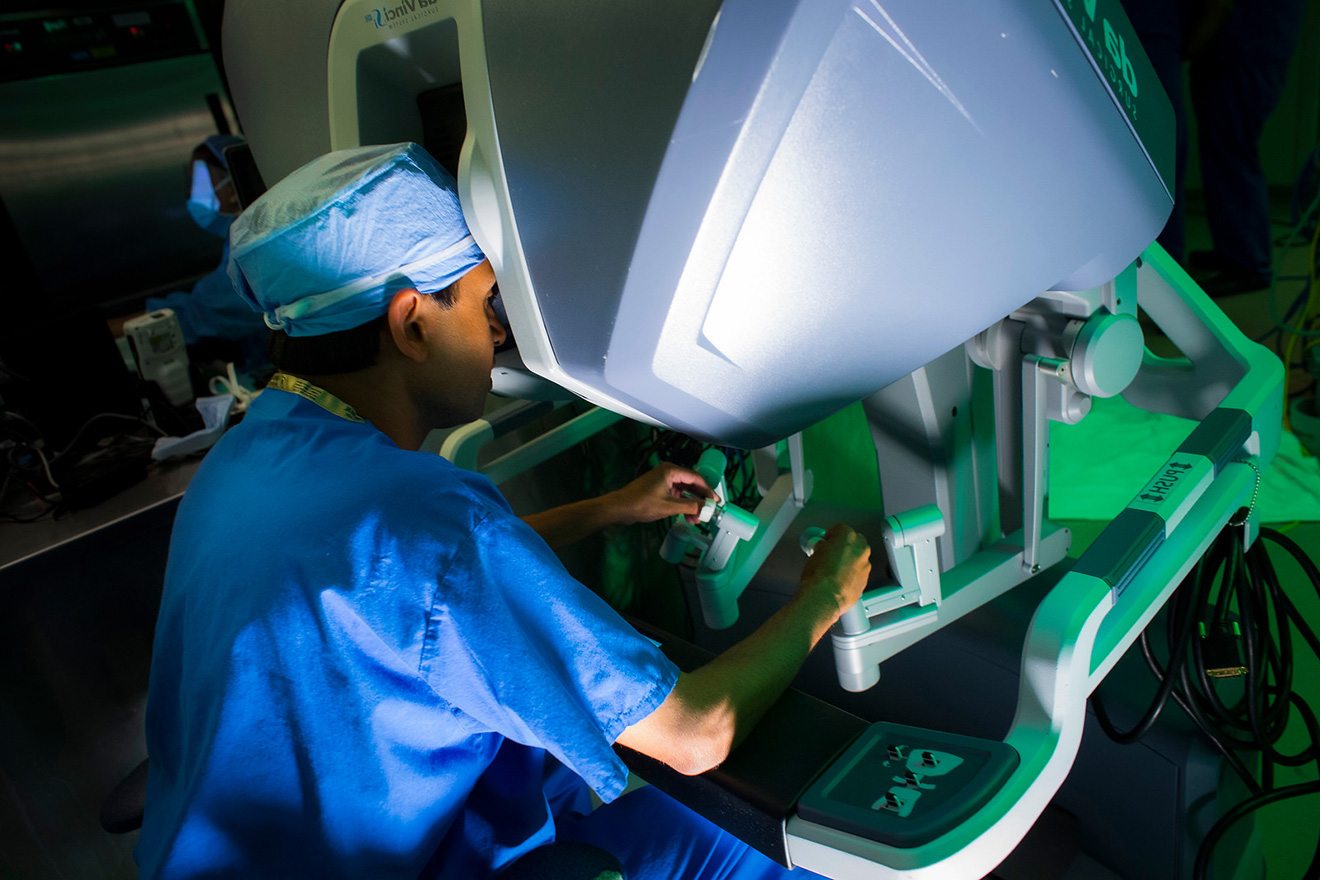
The robot is not self-thinking, but remotely controlled by the surgeon who drives its movement by head nodding, or moving it from right to left. A human would struggle to maintain a steady hand for the duration of such a procedure, which can often last for several hours. The robotic arm stays rock- steady, giving surgeons a clearer picture.
Limited access
Russell H. Taylor, a Johns Hopkins professor, is widely hailed as the father of medical robotics. He launched his robotics research more than four decades ago and began focusing on medical robotics more than 25 years ago, at a time when the field was virtually nonexistent.
Taylor has always emphasised that his goal is not to produce technology that would replace physicians but to give doctors new tools that can help them achieve better outcomes in treating their patients.
However, despite decades of successful robotic assisted surgeries in the US and developed countries that have positively impacted millions of patients, there is still limited access to this technology in developing economies.
There are two major problems – one is the cost of the system and the second is the expertise required to operate it. For example, a Da Vinci Surgical System costs about $2m, with hundreds of thousands in additional annual upkeep, while only one in five students at top-tier medical schools attains the necessary level of competency to work with these machines.
Dr. Sudhir Srivastava, a global expert in robot-assisted cardiac surgery, has been working on trying to solve these issues. His solution is to develop cheap, easy-to-use robots that more hospitals can deploy and that a wider base of surgeons around the world can use effectively.
His China-based company, SS Innovations (SSI), founded in 2017, is now demonstrating an affordable, modular robotic surgical system capable of complex motion control.
“Current robotic systems are far too expensive and take years to master, which means that very few surgeons are trained to operate these systems and much of the world is unable to access this technology,” he says.
One of the innovations that’s enabling the development of the SSI surgical system, and indeed a development that’s driving the spread of robotics in general, is the availability of off-the-shelf controls software.
Because SSI doesn’t need to develop a controls architecture from scratch, it’s been able to focus on hardware and unique solutions adapted to a wide user base.
One of the key innovations is the use of a software-enforced remote centre of motion (RCM), which keeps surgical instruments from moving side to side at the point of incision during minimally invasive surgeries. That takes an enormous burden off surgeons and makes robot-assisted surgeries easier.
SSI recently tested its system on 10 animals for one exploratory laparotomy (a surgical procedure involving a large incision through the abdominal wall, to gain access into the abdominal cavity) with promising results.
The key question
The key question is, what is the future of robot-assisted surgery in developing countries, especially in Africa given its multitude of needs and challenges? Opinion is divided.
Prokar Dasgupta, the first Professor of Robotic Surgery and Urological Innovation at King’s College London in 2009, the chairman of the King’s-Vattikuti Institute of Robotic Surgery and named as one of the top 10 prostate cancer surgeons in the UK in 2010 and 2018, says: “Costly robot-assisted surgery is not viable in the developing world considering that there is no convincing data on the superiority of these expensive robot technologies.”
On the other hand, Dr. Sudhir Rawal, one of the leading uro-genital surgeons in India, with a special interest in Robotic Surgery, says there is a clear need for a more efficient alternative to open and laparoscopic approaches.
He adds that there are opportunities to save money with robotic surgeries, that robotic procedures in India are much less expensive when compared, for instance, with the US.
“There are clear benefits in terms of blood loss, warm ischemia time, and a shorter learning curve for surgeons compared to laparoscopy,” he asserts.
But Professor Dasgupta insists: “Strive to become a better surgeon, particularly if you are in the developing world. Stop obsessing about technology. There are no differences in outcomes. Only 5% of operations are robotic. The cost of robot-assisted procedures rose by 13% in three years, resulting in around $2.5bn in additional healthcare costs. The robot is an unnecessary luxury in the developing world.”
He adds: “A fool with a tool is still a fool.”
Robot-assisted surgery is still in its early days and systems, as has been pointed out, are perhaps far too expensive to be put to general use in Africa today.
However, there is little doubt that given its advantages, surgery carried out by robots under the supervision of qualified operators will become the norm in the near future.
The example of how rapidly the mobile phone was not only adopted by Africa but also adapted for the needs of Africans is a clear indication that the continent can leap-frog intermediate technologies and go straight to the cutting edge.
Costs are coming down and training regimes, like for the Da Vinci system, are improving as well as becoming more affordable. Hospitals can group together to purchase systems and employ qualified staff. The large volume of patients needing surgery can make robotics cost-efficient, mobile robotic units can be a dream come true and surgeons from remote areas can have access to the robot. Let us not forget that when the age of the mobile phone began, African nations were seen as being too technically backward to be able to embrace it. The continent proved the pundits wrong and not only embraced the technology but developed it in ways undreamt of by the pioneers.
There is no doubt whatsoever, that the continent still lags far behind other regions when it comes to the provision of surgical interventions. Can robots deliver where traditional systems have failed? NA