While other countries focus more on commercial partnerships with Africa, the US has largely retained a humanitarian focus in its development assistance to the continent. Peter Guest examines the issues.
The Boeing Dreamliner connects Addis Ababa to Beijing, Guangzhou, Rio de Janeiro and São Paulo. Ethiopian Airways was only the second airline to take delivery of the aircraft, an early endorsement for the company in its seemingly eternal, and often brutal, competition with its European counterpart, Airbus. Supporting that deal with risk sharing and finance was the US Ex-Im Bank, which over the past decade has backed $2.2 billion worth of business between Ethiopian Airlines and Boeing.
Ex-Im Bank, established 80 years ago to support US businesses selling products to the Soviet Union, has since become a major financing organisation, backing more than $35bn of transactions in 2013, and helping massive US businesses, such as Boeing, General Electric and Caterpillar, secure orders in emerging markets. Since 1999, more than $5bn has gone to support American businesses in sub-Saharan Africa, including more than $2.2bn over a decade’s worth of deals between Boeing and Ethiopian Airlines. And yet, it is under threat. Congress has to renew the bank’s charter in September, and opposition is building within the Republican party.
Conservative lawmakers have accused the bank of “crony capitalism”, and the new Republican House Majority Leader, Kevin McCarthy, has said repeatedly that he believes the bank’s charter should be allowed to expire. The private sector, McCarthy has said, is better placed to provide the same services.
Jay Timmons, the president of the National Association of Manufacturers, a major US business lobby, has pleaded for the institution to be saved, saying that the services it provides are essential to American competitiveness.
“The debate over the future of the Ex-Im Bank comes down to whether we want products manufactured in the United States by American workers to win sales overseas, or whether we want our foreign competitors and their workers to take this business,” he said in a statement.
“A vote against the Ex-Im Bank is a vote to support growing manufacturing and jobs overseas and not in the United States.”
Other corporate heavyweights have come out to support the bank, which could be an important institution in broadening and deepening US corporate involvement in Africa, which has often remained heavily focused on the energy sector and held back by perceptions of risk. The tussle over Ex-Im Bank also neatly encapsulates the US government’s difficulties in helping its companies to expand into Africa and compete with the massive investment from Asia. Ideology, and internal disputes on the role of the state, continue to hamstring their efforts.
“While some elements in the Republican Party are openly debating the role of the US Ex-Im Bank, China is increasing its capacity in this area,” says Amadou Sy, a senior fellow in the Africa Growth Initiative at the Brookings Institution.
While Chinese government agencies have massively expanded their support for their companies overseas, moving quickly to pursue a pragmatic and proactive agenda of corporate expansion into fast-growing African markets, the US government has often seemed way behind the curve.
A White House summit in August is likely to be dominated by discussions over peace and security, but a solitary day devoted to commercial relations could create a framework for a more constructive engagement, Sy says.
Living off previous successes
At times, US policy can seem to be a patchwork, built up from each political generation’s headline initiatives. The Clinton administration’s African Growth and Opportunity Act (AGOA) offered African countries tariff-free access to American markets for their goods with a view to promoting development through private sector growth.
The Bush administration took a more humanitarian approach, launching the President’s Emergency Plan for Aids Relief (PEPFAR), which invests heavily in HIV/Aids initiatives around the continent. Under President Bush, Congress also voted through a bill creating the Millennium Challenge Corporation, a new kind of development institution that encouraged potential recipients to compete for eligibility and to essentially design and implement their own programmes.
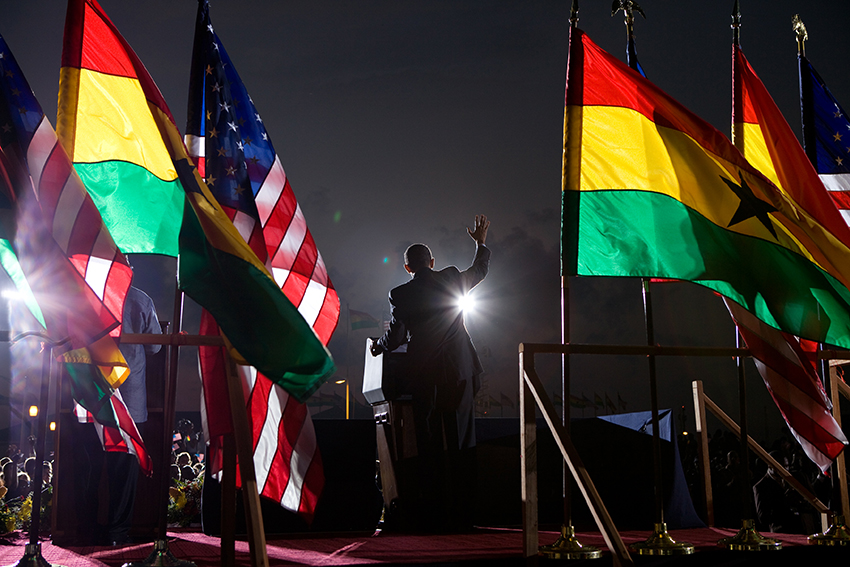
When Barack Obama won the 2008 election there was an enormous groundswell of support in many parts of Africa. His Kenyan heritage gave the US a great boost in its public diplomacy. Obama made his first speech in sub-Saharan Africa in Accra in July 2009. Entitled “A New Moment of Promise”, it emphasised the importance that the new government placed on its development partnerships but focused on governance, health, democracy and conflict resolution. At the time, some of the business community felt that it was a mis-step.
Over the previous decade, Africa’s international economic relations changed dramatically. Beijing’s international commercial ambitions drove a step-change in the country’s investments and trade partnerships, and by 2009 China was overtaking the US in the volume of business that it did with the continent. Chinese engagement meant money, in the form of soft loans and grants, but it also meant massive investment by the private sector into the extractive industries, infrastructure and, increasingly, manufacturing.
Beijing’s Forum on China-Africa Cooperation (FOCAC) summits have traditionally ended with big commitments to public sector lending – $20bn at the last event – but also big investment deals. China’s premiers and senior politicians routinely tour the continent, dropping cheques as they do so.
Japan has begun to ramp up its investments too, offering $30bn in aid at last year’s Tokyo International Conference on African Development. Japanese companies joined Prime Minister Shinzō Abe’s visit to the continent earlier this year.
While other countries began to focus on commercial partnerships, the US retained its humanitarian focus in its development assistance, perhaps more so than many Western countries. The past two administrations have maintained support for President Clinton’s AGOA, which offers free trade quotas for African countries to help them to develop productive sectors, but there is a widespread acknowledgement that the US has lagged behind other nations in encouraging its own private sector to participate in Africa’s growth story.
US foreign direct investment (FDI) into sub-Saharan Africa is still significant. In absolute terms, US companies’ investments into greenfield and brownfield projects outstrip all but France’s – if the EU is not counted as a single entity. According to statistics from the United Nations Conference on Trade and Development, US FDI stock was around $25bn in 2012.
However, as Sy points out, the size of the number obscures a lack of diversification. The majority of US FDI goes into the energy sector and other extractives, and is focused on a small number of resource-rich countries. In total, 37 per cent of US FDI goes to Nigeria. Patterns of trade tend to match this bias.
By comparison, Sy says, China’s trade and investment are increasingly diversified. Chinese mercantilist diplomacy has expanded beyond the mode it followed in the early 2000s, where infrastructure and soft loans were bartered for resources.
Today, China’s leaders tour the continent with large corporations in tow, bringing investment into light manufacturing, agro-processing and other productive sectors. The Asian approach offers speed and flexibility; US companies are, to a greater extent, hamstrung by process.
While Asian companies follow their governments overseas, the US, Sy notes, typically works the other way around.
In June 2013, the Obama administration finally proposed a different model for the future, mixing development goals with the stated aim of bringing in the private sector. While on a visit to South Africa, Obama launched Power Africa, an initiative aimed at doubling access to electricity in six African countries by adding 10,000 megawatts of power. Recognising that aid money alone was unlikely to be able to fill the $300bn investment gap in sub-Saharan Africa, USAID is coordinating with other agencies, including the US Ex-Im Bank, Overseas Private Investment Corporation and US Trade and Development Agency, but also with multinational companies, including General Electric.
“The thing with these power infrastructure projects is that they cannot be financed by [aid] grants,” Sy says. “Power Africa is interesting. There you have US agencies that are coordinated by USAID, and they are trying to partner with the US private sector, the African private sector and African governments.
“In the aid community these days there’s a lot of talk about blending of aid, leveraging aid to bring in the private sector. In that regard, Power Africa is a very interesting model.”
Even so, in absolute terms, Power Africa involves a tiny amount of state money. In USAID’s 2015 Congressional budget request, which asked for a total of $20.1bn, just $77m was allocated for the initiative.