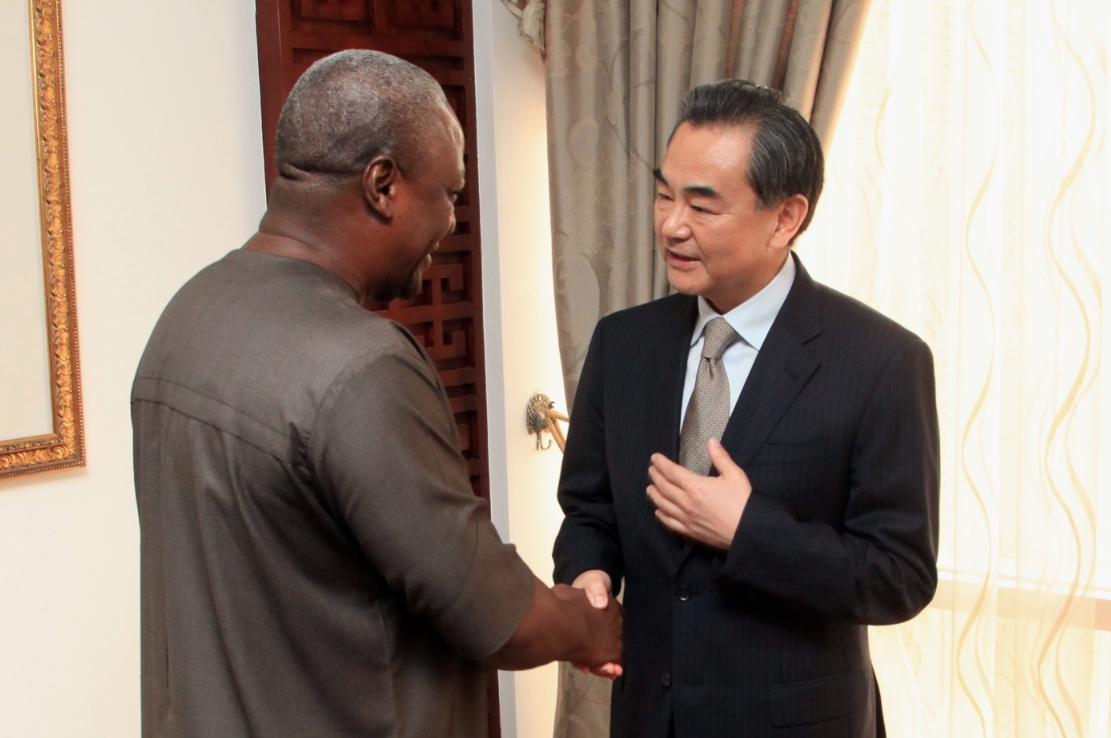
Once upon a time, the name of the game was Dollar or Euro Diplomac but today there is a subtle but determined shift, with the rise of the Yuan in global trade and international relations. In Ghana, China has found a new partner to the mutual advantage of the two countries. Stephen Gyasi Jnr reports from Accra.
Africa, the Asian giant still appears locked up in a tight competition with the USA and the rest of the West in terms of trade and rights to natural resources.
Over the past two decades, China’s presence in Africa has grown exponentially, from Algeria to Zimbabwe. The imprints are visible on the ground. Air and sea routes are increasingly developing between China and Africa, and massive deals are being made for commodities, trade, labour and military cooperation.
On top of this, Chinese private schools, eateries, embassies, and cultural centres are springing up all across the continent as African countries begin to recognise the role of the Yuan in their development. It is estimated that in the past decade alone, more than 800,000 Chinese businesses were established across Africa. According to the UK-based Economist magazine, trade between China and Africa was valued at about $166bn in 2011, from a mere $10.5bn in 2000. China is now Africa’s largest trading partner, having surpassed the USA in 2009. This has been helped largely by China’s policy of non-interference in the internal affairs of African countries, and its quick approach to aid delivery. China provides aid in the form of hard cash or investment in physical infrastructure, like assisting to build schools, hospitals, roads, railways, dams, agribusiness, and sending out doctors to help in poor countries. With these and many developments going on across the continent, some experts contend that Africa is chewing too quickly at the juicy carrot being dangled by China, and in the process getting short-changed by importing cheap Chinese goods while exporting valuable commodities like oil and timber.
Ghana-China relations
One of the African countries that has really caught the Chinese bug is Ghana. Relations between the West African country and China go back a long way, with diplomatic contact being established in 1960. Since then Ghana has provided substantial diplomatic support to China at the United Nations, an effort that China has reciprocated with material and financial support for Ghana’s development. Bilateral trade between Ghana and China reached $3.5bn in 2011, an incredible growth of 69%. China encourages non-traditional exports from Ghana such as agricultural products, which give Ghana a relative advantage in marketing competition.
China’s investment areas in Ghana have mainly been in construction, mining, steel industry, building materials industry, chemical industry, the pharmaceutical sector, food processing, fisheries, agriculture, slate production, and power plants, among others.
According to the Ghana Investment Promotion Council (GIPC), 2011 saw 79 Chinese investment projects registered with a total value of $145m, while in 2012, China registered 56 projects, making it the top investor in the country in terms of the number of registered projects, though Lebanon ranked first with $1.49bn for 2012, making the Arab nation the single largest source of foreign direct investment in Ghana for that year. Other figures show that more than 30 Chinese companies were engaged in project contracting in Ghana by the end of 2011. The value of the newly-signed contracts totalled $1.57bn.
China has also been on a spending spree in Ghana, supporting the construction of infrastructure. The China Development Bank, for instance, has committed to providing aid assistance to the government of Ghana to the tune of $3bn in commercial loans to cover 12 projects, including oil and gas, irrigation of the Accra plains, rehabilitation of the western corridor railway infrastructure, and the retrofitting of the Takoradi port, among others.