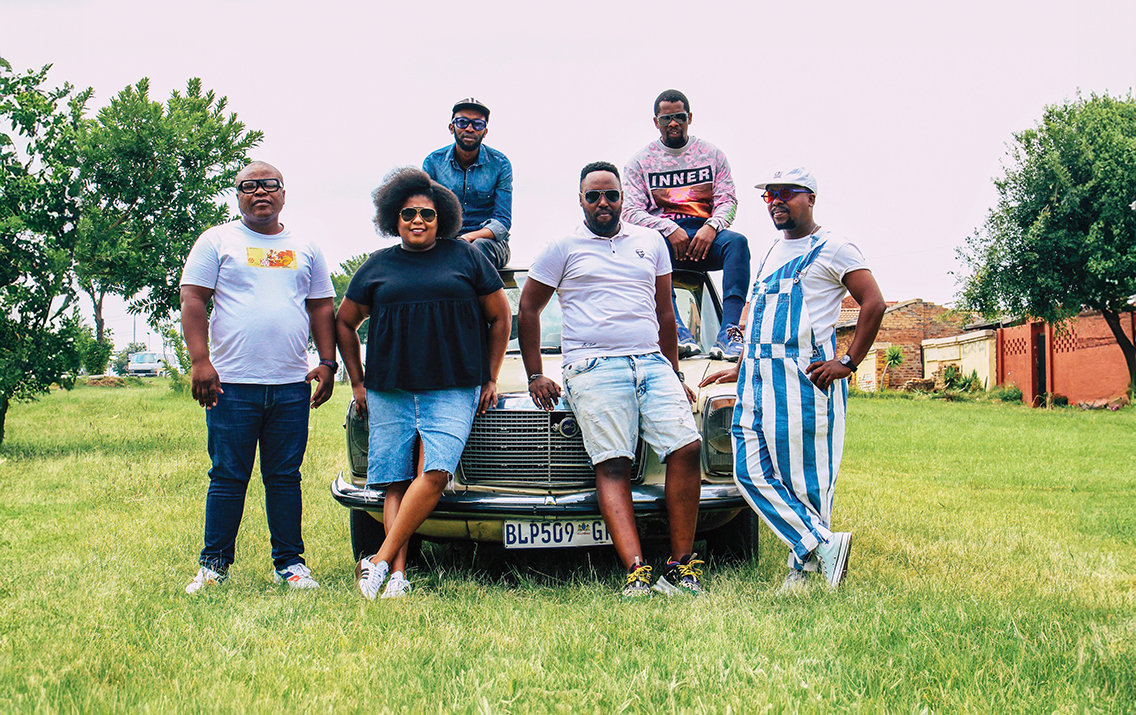
Part Soweto street sounds, part Afrofuturist electronica, BCUC’s music embodies all the hope and chaos of the new South Africa.
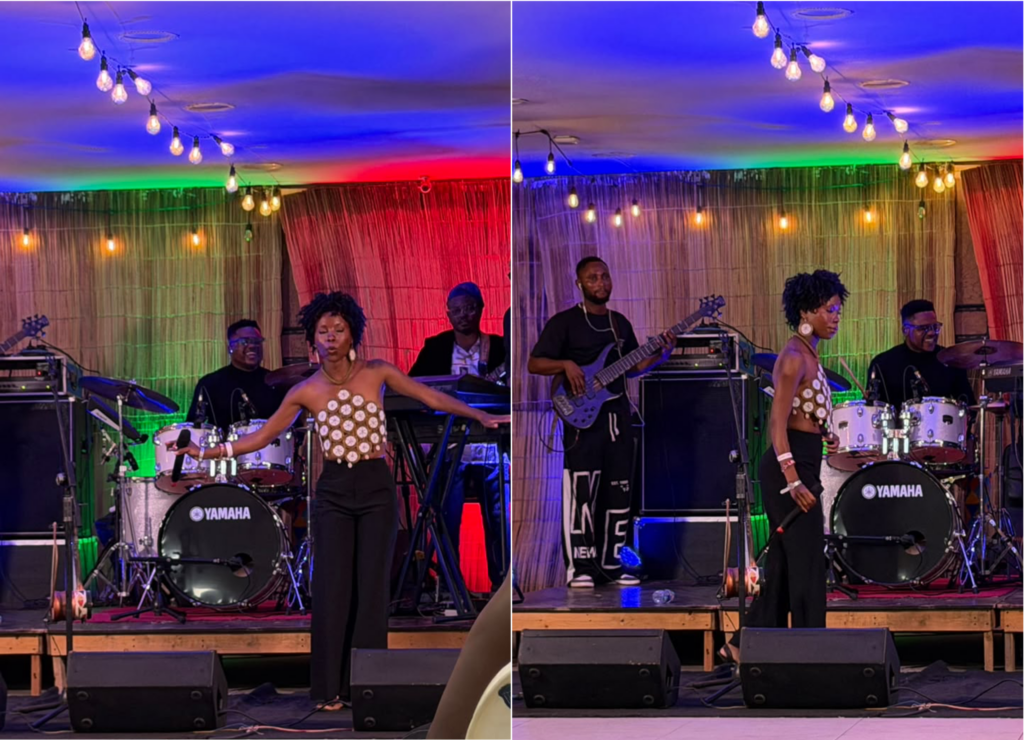
BCUC, the seven-person South African band whose acronym stands for Bantu Continua Uhuru Consciousness, have been together for two decades and through it all remain committed to their unique artistic vision, embracing spiritual and political liberation.
The band, consisting of Nkosi ‘Jovi’ Zithulele, Kgomotso Mokone, Thabo ‘Cheex’ Mangle, Mritho Luja, Lehlohonolo ‘Hloni’ Maphunye and Skhumbuzo Mahlangu, with Mosebetsi Ntsimande of the band Uju as a featured bassist, sing in all of South Africa’s 11 official languages.
With their mesmeric and often spontaneous incantations in Zulu, Sotho and English, married to a rainbow of influences ranging from Sun Ra to Sam Cook, they are singing as much for their ancestors as for their legions of fans throughout Africa, Europe and North America.
And yet their innovative style blends old and new, to evoke both South Africa’s rich history as well as its future.
Their first album, 2016’s Our Truth, whose cover featured a group of South African women, miners, and other workers – their fists in the air below a large BCUC flag – boasts a musical intensity that matches the visuals.
Here, the band that started in a community centre workshop and rehearsed in a shipping-container-turned-local-eatery opposite the church where Desmond Tutu preached, demonstrate their self-styled ‘Africangungungu’, the name they’ve given to their ‘Afropsychedelic’ music.
Channelling Philip ‘Malombo’ Tabane and Batsumi, their music is influenced by traditional chanting, jazz, Afrobeat and even punk rock. At once angry, urgent and optimistic, its raw energy is a powerful expression of the South African soundscape and manages to capture the nation’s reality musically. Ancestral war songs mix with rap and soul elements, Nguni and Tsonga rhythms and the whistles of miners, all blending into an irresistible trance beat.
The opening track is the high octane Yinde, which means ‘the road’ and might well refer to the long one the rainbow nation still has to travel. Asazani (“we don’t know one other”) is a heartfelt cry for reconciliation while In My Blues sounds like BB King on African acid.
2018’s Emakhosini, recorded in Lyon, France, features Fela-inflected cries for the rights of exploited workers, mixed with township-style vocals and ancestral incantations.
2019’s The Healing demonstrates the band’s manifesto belief: “We are descended from tribes who use music as therapy.”
With the likes of the 19-minute- long The Journey with Mr Van der Merwe, which is less like a song and more like a wild ride through repetitive chants, riffs and percussion, all marshalled by a throbbing funky bass line; and the shorter but equally potent four-minute Isivunguvung, listeners to the album, produced in Paris, emerge transformed by its South African magic.
The band’s last album, 2023’s Millions of Us, recorded during a Covid lockdown, boasts a mesmerising track, Thonga Lami, that mixes spoken word with haunting background vocals and percussive riffs, immersing listeners in a warm audiobath of Soweto sounds.
Improvisational trance
When I caught up with the band’s two lead singers, Nkosi Zithulele and Kgomotso Mokone, they were at the Vancouver International Folk Music Festival en route to a European tour that wraps up at the end of this summer.
According to Zithulele, their new album – still nameless – is already recorded and to be released by the end of the year.
“It’s a continuation of the previous album Millions of Us,” he explains, “a series of songs we recorded during Covid lockdown in 2021”. While the style is in a similar vein, he says, “we never have two songs that are the same.”
The upcoming album is an attempt to experiment with shorter songs, while still keeping the feeling of continuous improvisational trance typical of their music. But trying to make the transcendent and the psychedelic finite is no mean feat.
“Whenever we’re on stage,” say Mokone, “the audience co-creates the experience and the sound. So, it’s a huge challenge to try and capture that live feel in the studio.”
“We still don’t know how it will be received,” admits Zithulele – but if it’s anything like the enthusiastic reception the band received at the Vancouver International Folk Festival, he has nothing to worry about.
BCUC’s creative process, they explain, is about constant refinement and experimentation. While drawing on diverse influences ranging from Afrobeat, Afro-futurism and traditional tribal chanting,
“Just because you are South African,” explains Zithulele, “doesn’t mean you have to tie yourself to that one experience or tradition. You can have multiple experiences and include them in your art.”
Church music, prison music, songs of their grandmothers, all contribute to being “a window into what the South African audio tapestry is all about. And we are only a little part of what is about to come – because we lead this new movement of including all cultures in one band.”
“Before,” he says, “you had to be just a Zulu band or just a Tsonga band or just a Xhosa band. But we sing songs in all eleven official languages.”
The band’s inclusivity mirrors a process that is happening both in Soweto and in South Africa as a whole.
“Soweto now is in the middle of a transformation. It’s a township that is slowly becoming a city – that is slowly becoming a South African experience. Soweto is becoming like a little South Africa in this beautiful mix of tribal peoples.”
At the same time, he notes: “If you go to suburbs next to Soweto, they are mixed and multicultural with people from around the world. And other places are becoming like little Zimbabwe – little Nigeria – little Ethiopia.”
Soon, he says, even Soweto will have its own Chinatown.
“Whether we like it or not, we are seen as a source of hope for Africa. But it doesn’t mean that [foreign] people are taking our place. Some people have been here for 20 years, and they are calling South Africa home, so who are we to say, ‘Hey, you go back home?’ Because they’re already South Africans, they have made a family – their kids only know South Africa as their home.”
The overall effect, Zithulele, notes, lends a new texture to South Africanness – one that continues to be reflected in the music of BCUC, who have been collaborating with different African musicians for years. Their songs, he says, are part of the search for a new identity. But while “lots of bands think that new identity is in sound – it actually starts from thought. For every revolution, there needs to be a cohesive thought. So, in Soweto now – we are trying to find that cohesive thought.”
And what exactly will that thought sound like? It’s a work in progress, they say.
Their songs are about resilience and “trying to transcend the duality of existence. We are constantly aware of who the people say we are – and constantly trying to find who we are becoming.”
The band’s struggle to encapsulate the live improvisational feel of performance into a recording is mirrored by the evolution of their music. “By the time our music is released in an album,” explains Mokone, “it’s already evolved into something new. Even songs we have played for 10 years – we’re constantly working on them and adding to them. We aren’t faithful to what the song says – we control the songs.
“Sometimes we stop playing a song that people love. They complain and say, ‘why don’t you play that one?’ And we say, it’s because we have another song that we think you need to hear. And you won’t know how amazing these songs are because you still miss the old one.”