With beauty and compassion, Abderrahmane Sissako’s feature film Timbuktu tells the story of life under brutal Islamist rule. Beverly Andrews reflects on its message and the tragic tales it tells.
Timbuktu’s history is legendary. During the 12th century, it was a world-renowned centre for commerce and Islamic studies. Over the centuries, scholars throughout the world have used its historic libraries to trace the region’s illustrious past, while many in Africa view its historic importance as comparable to that of Rome. Because of the area’s cultural and historical importance, the world was shocked to see it threatened with complete destruction in 2012, when Islamist militants swept across northern Mali, imposing brutal control over its towns and peoples.
Abderrahmane Sissako’s stunning new feature Timbuktu traces this year-long occupation of the city in 2012 and, through fictionalised stories inspired by what really happened, documents the destruction left in its wake.
The tone of the film is set in the opening scene when we see militia members using beautiful ancient artefacts for target practice. To them, anything of beauty is seen as a threat to their radical interpretation of the Koran, an interpretation challenged early on in the film when the same militia members enter a mosque carrying loaded weapons. The town’s cleric admonishes them for not respecting the house of God, while they challenge him by saying they are there for jihad (holy war). The cleric smiles sadly and says that so is he, except that his jihad is that of internal transformation, not the irrational destruction of another society.
Through this scene and others, the interpretation, or rather misinterpretation, of faith is one of the key themes explored in Timbuktu, at a time when this has become an issue of fundamental importance throughout the region. Recently, this has been most clearly highlighted by the actions of the northern Nigerian group Boko Haram which, along with countless armed attacks and bombings, kidnapped around 200 school girls earlier in the year. As Sissako said in a recent interview, his hope is that “the film could help people understand. Not to change anything, but to give an insight into these themes and issues.”
Some of the clashes of religious interpretation are presented comically in the film, such as when the Islamist militants, having passed a ban against the playing or listening of music in a city renowned for its musicians, hear music coming from one of the town’s houses. They desperately try to locate its source only to discover that the music being sung is a religious hymn praising the prophet. They frantically call their commander on “their Western mobiles” to try to work out what to do. They need advice on whether because the music being sung is religious it is still prohibited.
Another comic/tragic moment comes when a young local musician is forced to give a filmed interview condemning Western music.
The boy tries several times to get the words out, words which have been written for him, but despite the militia commander demonstrating how the message should be said, the teenager simply cannot bring himself to say it. What is tragic though is that later on you see this same boy now carrying a weapon, a fully-fledged member of the militia. This tiny but significant incident shows the corrupting effect the invasion has on the younger generation of the town.
In a country famous for its liberal interpretation of Islam, a strict form of Sharia law is imposed and the viewer sees the consequences of this along with its many contradictions. The brutal stoning of a nameless couple is shown as well as the shocking actions of a fighter who feels he is entitled to any woman he desires.
This militant approaches the mother of a young girl and asks for her daughter’s hand in marriage. When the woman refuses, saying that it is not the custom of the community to give the hand of a girl to a complete stranger while her father is away, the fighter responds by saying that he will simply take her since it is his right. You later see the same girl in tears on her enforced wedding night.
When the woman refuses, saying that it is not the custom of the community to give the hand of a girl to a complete stranger while her father is away, the fighter responds by saying that he will simply take her since it is his right.
A story which forms Timbuktu’s core is that of a nomadic couple who, with their young daughter, watch in horror at what is taking place in the town. They hope their distant encampment will protect them, but sadly this is not the case since the beautiful wife soon attracts the attention of the militia’s commander who visits her daily while her husband is away. The woman tries to persuade her husband that they should leave as she gets increasingly worried about these visits, but her husband refuses since he fears that if the family move, they might find themselves in an area suffering from drought. In many ways this couple’s sad story serves as a microcosm of the entire community who, despite their desperate efforts to carry on with their lives, find themselves inexplicably pulled into the conflict.
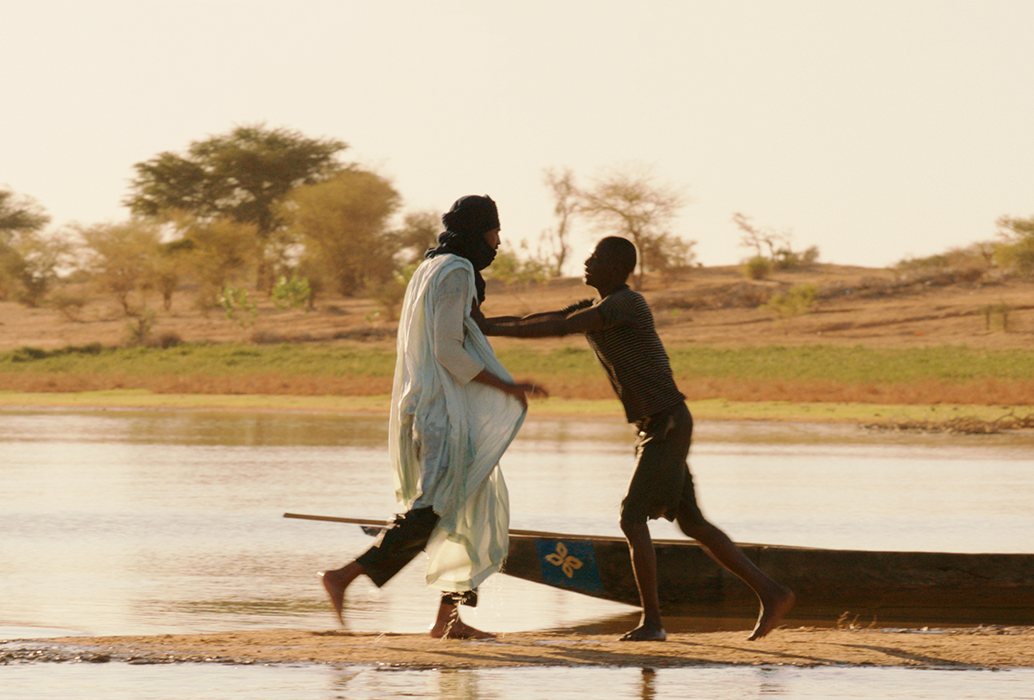
For the nomadic couple, their lives are shattered when the husband’s prized cow is killed by a local fisherman. The husband confronts the man, and in the subsequent struggle the gun he is carrying discharges and the fisherman is accidentally killed. The husband is arrested and brought before a religious tribunal who choose not to investigate the circumstances surrounding the incident. Without notifying his worried family, they sentence him to death. Crying, the man says he accepts the verdict but is worried about his daughter and wife’s future. The cleric turns to the court clerk and says in an all too rare display of humanity that he too worries for the future of the man’s family. Hardening his resolve, however, the cleric then turns back to the man and upholds his death sentence.
These tiny displays of internal conflicts within militant ranks are shown throughout the film, as when the soldiers looking for the source of the offending music pause for a moment to listen to its beauty, or when it is made clear the militia leader is in love with the nomad’s wife but incapable of articulating his feelings.
At one point, the frustrated leader orders his driver to stop as they pass a patch of green grass in the desert. The militant takes out his gun and razes the grass before telling his driver to move on. It is as if at the very moment of confronting something beautiful, his immediate response is to find a way to destroy it.
“I didn’t want to have a Manichean attitude, to have good on one side and bad on the other. That’s not the way it is in real life … History has proven many times to us, that very often it’s our neighbours who become our hangmen.”
Of a desire to humanise the invaders, Sissako has commented: “My starting point was to think of them as human beings like us.” He went on to say: “I didn’t want to have a Manichean attitude, to have good on one side and bad on the other. That’s not the way it is in real life … History has proven many times to us, that very often it’s our neighbours who become our hangmen.”
In early 2013, a combination of French and Malian forces eventually drove the Islamist militia out of Timbuktu and their strongholds in the north. It was a liberation which brought many Malians onto the streets to celebrate. Sissako’s groundbreaking film recounts the trauma of the period before they were rescued, a dark time that few will want repeated.