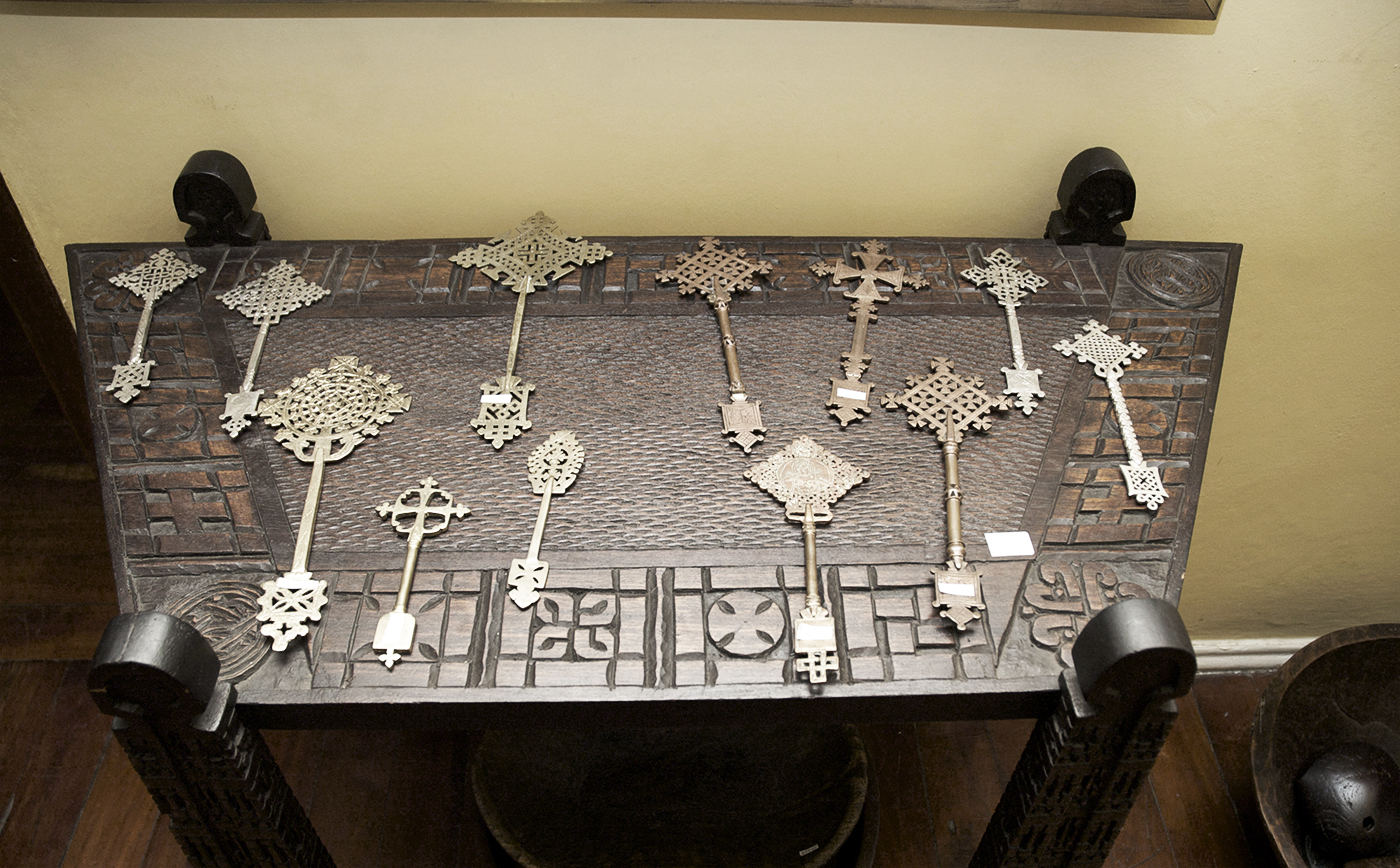
St George Gallery, located in downtown Addis Ababa, is the centre for an extraordinary artistic endeavour. The gallery’s founder and managing director, Saba Alene, designs and manufactures furniture and textiles of breathtaking quality. She also exhibits many of Ethiopia’s top contemporary artists and displays antique treasures from Ethiopia – what she describes as her country’s “hidden treasures”.
How Saba built her business is a story in itself. Leaving high school at 15, she began working in her brother-in-law’s family’s furniture business while also attending night school. It was a time of huge social upheaval with Mengistu Haile Mariam’s regime in power and the student population (within which she was an activist) being purged.
It was also a time when a woman’s place was considered to be in the home, so she astounded her work colleagues by first succeeding in becoming a top sales person then, as well as dealing with the customers, going onto the shop floor to manage the manufacturing side of the business.
“It was challenging!” Saba explains. “First, I had to learn some of the techniques of woodwork which took two or three years, and then master the skills of a production manager – well, the small team I was working with had never seen a woman carpenter, nor worked for a woman boss. So it took them some time, but they came around to accepting it. They got used to me!”
Even at this time, Saba was developing a passion for Ethiopian antiquities. People thought she might be a little crazy, but she began to collect and lovingly restore old furniture. She also developed a passion for old books, mainly religious texts, some illustrated and invariably written on parchment in Ge’ez (the ancient language of Ethiopia). Her strategy was to search them out in small second-hand stores, and negotiate with the owner. She would put a little money down, and then use her very modest salary from the furniture business to make further payments for as long as it took to buy the pieces outright.
She was to continue working for 14 years with the family business before she decided she just had to follow her own dreams. She left the company with just Birr20 in her pocket (less than $2), but fate was to treat her kindly. A friend offered her office space, and almost out of the blue she was asked if she could design a wall for a compound.
It seemed an unlikely commission, but she jumped at the opportunity.
“I’d never done anything like it before, but I grabbed at it,” she remembers. Her new patron was so impressed with her skill and commitment that he asked her to undertake other work, including interior designing. From there, other clients came to her for design advice. Her business prospered and she began to earn relatively good money.
One of Saba’s childhood dreams was to open an art gallery – but galleries were unknown in Ethiopia at that time. Using the money that she was earning from her interior design consultancy, she decided it was time to follow that dream and she started to hunt around for a suitable space.
Again, good fortune smiled upon her. A young real estate entrepreneur found her an old colonial-era Italian-styled house. It was up for sale, lived in but very dilapidated. The day she saw it she knew she wanted it; and to this day, this is where the St George Art Gallery and Interior Design Company is based.
“Even my family were a little unsure about this,” Saba remembers, “except my young sister Selama and my mother who encouraged me.” She moved into the premises and began restoring the house to its former glory. It is not a large house but outbuildings accommodate furniture, textile, ceramics and painting workshops.
She has not lost the ability to manage a shop floor and – as well as designing furniture, running the gallery and dealing with her clients – she keeps a watchful eye on the quality of all the gallery’s output.
From the day the St George Gallery was inaugurated with an opening party, it has proved highly successful. It is not just the sizable well-heeled diplomatic corps based in Addis Ababa nor international visitors to the city that have become her loyal clients; she has also started a trend among wealthy Ethiopians to buy art for art’s sake and, perhaps more importantly, to take a closer interest in and appreciation of the country’s hugely important cultural heritage. And since speaking to New African, Saba has achieved another dream – to open a St George Gallery in the US, in Alexandra, Virginia to be precise.
It is notable that Saba is not simply tied to tradition; her furniture might incorporate many carvings of traditional Ethiopian symbols and use age-old manufacturing techniques (as well as make extensive use of indigenous woods and other materials) but they are distinctly contemporary. A good example of this is what Saba calls her Axum chair. It may not be traditionally shaped, but it is manufactured from a fine-grained local hardwood and the seatback carved with designs that echo the great standing pillars (or stellae) of Axum.
Then there are the upholstered sofas and chairs, named after her mother and sister respectively, that feature ornately carved arms and surrounds, while the shape of them is utterly modern. And alongside these works are displayed the antique items that she has saved. Many, such as the large barrel-shaped Jimma chairs (named after the region they originated from) come to her workshop damaged, the wood split and caked in centuries of wood smoke and dirt. These are given a new lease of life by being stripped, splits and damage repaired before multiple protective layers of bees wax are lovingly applied. It is a time-consuming process, but one that gives the wood a lustrous shine once again.
However, it is her contemporary furniture designs for which she is most famous – for example, she won the prestigious 2005 World Intellectual Property Organisation award for industrial design, receiving the award from Ethiopia’s President Girma Wolde Giorgis. But this recognition, and the publicity it encourages, has bred, she admits frankly, a certain amount of envy among her peers – with some of the more unethical even attempting to cash-in by copying her designs. She counters this by ensuring her metal logo is embedded in every piece of genuine St George Gallery furniture.
This fame does have its advantages though. It not only attracts many VIPs to the gallery, perhaps the most famous being former US President Bill Clinton, but it also gives her the ear of government ministers. This allows her to lobby for greater support for Ethiopia’s creative arts. For example, she never wastes the opportunity to argue that the government should buy Ethiopian art, furniture and artefacts for the country’s embassies around the globe. That would not only serve to showcase Ethiopian design to the world, but ensure the skills of the country’s artisans and their crafts are preserved as well as provide Ethiopian artists with international exposure.