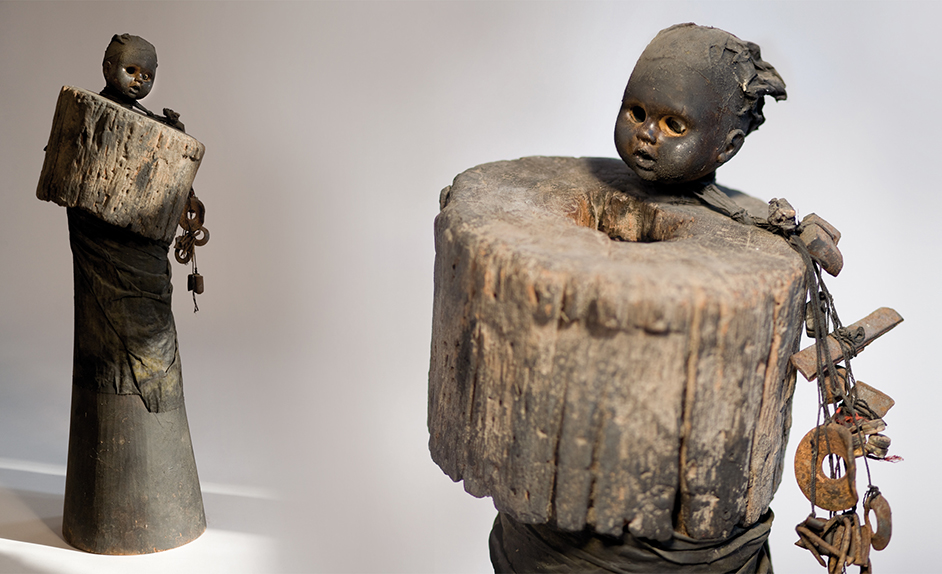
A Benin artist, Gérard Quenum, has brought a whole new meaning to old, torn, and discarded dolls. He makes them live again. “I love the dolls,” he says. “I don’t make them just in order to sell them. I create them because this is something that comes from within me.” Juliet Highet went to see a recent exhibition of Quenum’s work in London.
“Can a doll know death? No: dolls grow, they acquire speech and gait, they perambulate the world; they age, they wither, they perish; they are wheeled into the fire or buried in the earth; but they do not die. They exist forever in that moment of petrified surprise prior to all recollection when a life is taken away, a life not theirs but in whose place they are left behind as a token, living not life but an idea of life, immortal, undying, like all ideas” – J. M. Coetzee in Age of Iron.
J. M. Coetzee succinctly evokes the disquieting fascination we have for dolls, and in Gérard Quenum’s case – especially if they are damaged – transposed into an alien context, and in addition altered so that they evoke disturbing feelings inside those who meet them.
Like many contemporary African creators, particularly a rising young generation of sophisticated “street artists” from Benin, Quenum (who is also from Benin) uses found objects, whose chequered past is an essential element in the significance as well as the actual composition of their work.
“Re-cycled” and “found” articles are a particularly potent component of sculpture of course – since they are actually the sculpture, rather than an add-on, say in the case of painting.
Quenum stands out as one of the most original exponents of this distinct sculptural style using urban detritus. What gives his art an unexpected frisson is his use of unwanted dolls. We take it as read that the original intention of “dolls” is as appealing, endearing toys for small children, particularly for little girls to cuddle and “look after”.
All of Quenum’s dolls were made in the West, then discarded, and shipped to Africa as part of aid consignments by no doubt well-meaning organisations. Of course these rejected, often damaged dolls are rarely black. In fact the idealised Barbie doll quotient of a throw-away excessive-consumer society adds to the disturbing questions swirling around what become the toys of African street kids or those of poor families. When finally they are thrown away again, the dolls are in bad shape – missing a limb or an eye or worse.
Quenum comments on his first encounter with one of these “found” objects that once was a beloved toy, in a muddy puddle: “It was in a pitiful state – abandoned, half-drowned, its hair caked with filthy mud – and yet its eyes still held the glimmer of an anguished expression that cried out to me…
“Whenever I see a battered old doll that’s been played with for years and suffered at the hands of so many strangers, I still get waves of compassion welling up within. So I rescue it and start to work directly with whatever it is I have chanced upon. I let the object itself prompt me and suggest whichever other bits and pieces I have already collected in the atelier be called into play.
“If you like, the face of each doll inspires me, almost as if the doll were telling me its history, and my job is to understand and then to surround it with whatever props are necessary to render that story visible…
“I’m prompted to give these ‘foundlings’ a safe place from where they can recount the stories of the things they’ve been through… I can’t work with any object that’s brand-new or completely clean, since it wouldn’t contain that essential vibration which allows me to intuit the things about which it’s trying to tell me.”
Quenum takes these dolls and transforms them by various processes, which in themselves give gruesome rein to the imagination. With a blow-torch, he blackens the white skin making the doll darker, literally and metaphorically, and singes the blonde hair into an “Afro” style.
They are still chubby babies, (apart from Barbie), though somehow their look of innocence has morphed into “petrified surprise” as Coetzee puts it, as large nails are driven into the throat of Night Watchman. Eyes become unseeing – obliterated with clay as in Angel (Angel of Death?) or one-eyed for Soothsayer, or dark, hollow sockets for Sacrificer. To these spongy plastic dolls, Quenum adds material such as fragments of old weathered wooden piles that once supported houses in the marshy lagoons surrounding Porto Novo, the city in which Quenum was born in Benin.
Other objects like mortars for pounding grain, crude metal “jewellery” wound around plastic necks, cowries, dried animal skins, drums and masks formerly used for rituals, speak of hidden histories, inherited myths and unforgotten ancestral lives impregnated in the resultant sculptures.
The Reaper (as in “Grim Reaper”) is accompanied by a threatening scythe, and this time its victim, another doll, hangs limply, well and truly dead. Additions to the dolls at a recent London exhibition throbbed more with sinister implications than ever. One vast, creeping installation called Death to the Dictator, Long Live Dictatorship was topped by nine military helmets, its one doll skewered through the head by an antenna.
The shoulders of Carnival Mystery are draped in a grisly animal skin, dismembered limbs stick out from the body – an old drum. The eyeless head of Sacrificer is perched on the edge on another more termite-eaten drum, whose hollow is filled with bent, rusty nails.
Quenum then transforms his once “innocent” dolls another way. They weave a narrative of his telling, brought to life, not only by their powerful macabre presence, along with their ghoulish paraphernalia, but also by the indignities and the injustice they represent.
Some people find them appealing, endearing, even whimsical. I do not. I find them poignant, frightening and tragic.
However, Gerard Houghton, director of special projects at the October Gallery, London, writes: “I read Quenum’s dolls as actors, metaphoric interpreters, heroic figures… they are survivors, remaining unharmed, managing to retain an innocence about them, a sense of hope, an intimation of the fantastic potentiality of the human spirit.” Quenum’s work has the ability to synthesise, with an incredible economy of means he portrays the cruellest of actualities.
What are these indignities, these cruelties embodied in Quenum’s dolls? They are his protest, his revolt, his pain at the injustices inflicted on children throughout the world, and most especially in Africa.
Quenum says: “They are not responsible for war, but they are the first to be its victims. When I reflect on this, I am in spiritual communication with them.” Daily, the awful realities of children in his neighbourhood, dying of poverty and disease, prompt his passion to express in his art the suffering he observes around him.
On the other hand, Quenum says: “There’s never any intention on my part to shock or to provoke people. Obviously, the works can be quite intense, and it’s not necessarily the sort of art that everyone might want in their living room.
“People are constantly fed with violent images of Africa and hear about different wars and atrocities and they end up imagining Africa is really like that. I’m also talking about real things or real people that no one seems to notice very much, like (his sculpture) Nomad on the Edge of the Desert.
“These are some nomadic peoples in the north of Benin, people who live a very difficult life and have to move around a lot to eke a living from the barren lands along the edges of the desert. What interests me about these people is that they own nothing and yet understand how to survive with just their basic knowledge of the way things function.
“They only carry a limited number of things with them: a simple piece of clothing, a handful of nuts, maybe a basic tool and yet with those few items they live their complete lives from cradle to grave”.
There is another aspect of Quenum’s sculpture, that of the ancient, still vital spiritual traditions of Benin, epitomised by assemblages like Soothsayer or Diviner from the French Devin, and Babalawos, who have supernatural divining powers.
Quenum comments: “A large part of my life has been spent in the middle of a very traditional culture, and evidently that has marked my development and finds reflection in my art. My grandmother was a priestess of a traditional society and many of the influences in my development as an artist come from those sources. I pay my respects to the ancestral traditions by mining those resources for new content today.”
The Bocio, for example, is a totem figure, representing either an individual, a family, a deceased member of that family, or a spirit. Quenum says: “It’s something that’s occupied me recently – a return to older sculptures such as Bocio, those traditional sculptures from long ago, which describe the manner in which people used to deal with difficult issues and at the same time represent other more complex ideas…
“They have almost disappeared today; forgotten, lost, or without any spiritual value. Fascinated by their simplicity and the stories that lie hidden within them, they inspire me to use woods which are old and have ‘lived’, old dolls which still hide all sorts of histories, so that I can pursue, in this present moment, the work of my ancestors. My work is made by confronting tradition with modernity”.
Quenum was born in 1971 in Porto Novo. He had to leave school very early to work, and taught himself to draw, along with other young ‘street artists’, who similarly, had no formal art education.
They arranged exhibitions of their work, “not in fine art galleries (of which Benin boasts precious few!)”, as Gerard Houghton points out, “but outside on the city streets, amongst the people. They called this succession of guerrilla street exhibitions ‘Boulev’art’ (Art on the Boulevard)… Today his pieces can be found in galleries on the grand Boulevards of Paris, not to mention the finer streets of London”. And indeed, shown internationally, with a long pedigree of solo and group exhibitions. Prestigious public collections have acquired his work too, including the British Museum, the Museum Afro-Brasil in São Paulo, and Stanford University, California. In the last few years, contemporary African art has achieved a global profile, along with augmenting sale prices. London’s October Gallery has been the only venue to mount solo shows in Britain, one in 2009, another in the autumn of 2012 titled Dolls Never Die. Writing the catalogue for the latest show, Gerard Houghton asked Quenum whether the recent attention focused on African contemporary art had affected his own practice. Quenum replied: “It always makes me chuckle to hear that we’ve now been elevated, in Africa, from doing primitive art to being truly contemporary artists. What I’m doing today is no different from what my ancestors have done for centuries. If that’s the name you want to give it – it’s always been ‘contemporary’.
“Even if the West finds it surprising that we now do ‘installations’, it’s something we’ve always done – I do art like this because I was raised in that environment and don’t need any approving label of ‘contemporary art’ to know what I’m doing.”
Quenum’s belief is that an artist should first be a messenger, then an aesthete. “There are people who say that it is necessary to see beauty everywhere, but when you pass through the street where people die of starvation, or you see on television images of war and death, you have to admit to recognising misery and suffering.
“I love the dolls, I don’t make them just to sell them. I create them because this is something that comes from within.”