The year 2014 began and ends on a high note in terms of Africa’s contemporary art and London has been a great hub that has attracted and showcased some of the continent’s highly acclaimed visual artists through events such as the just concluded 1:54 Contemporary African Art Fair, and the highly successful ‘Africa Now’ auction, which took place earlier in the year and saw record sales figures for African arts. Here Juliet Highet revisits the latter.
This year saw Africa’s contemporary art come into sharp focus. According to the exclusive auction house Bonham’s, African art, created by artists from a multitude of cultures, reflects the complex heritage of a dynamic continent and demonstrates tremendous potential for investment in the sector. “Africa Now”, the arts auction organised by Bonhams, brought together the very best of post-war and contemporary art from across the African continent in various media, including painting, sculpture, and drawing.
According to Giles Peppiatt, Director of African Art at Bonhams: “A lot of collectors are looking at the contemporary African art market thinking it might be the next China, where an interest in collecting its art has exploded.”
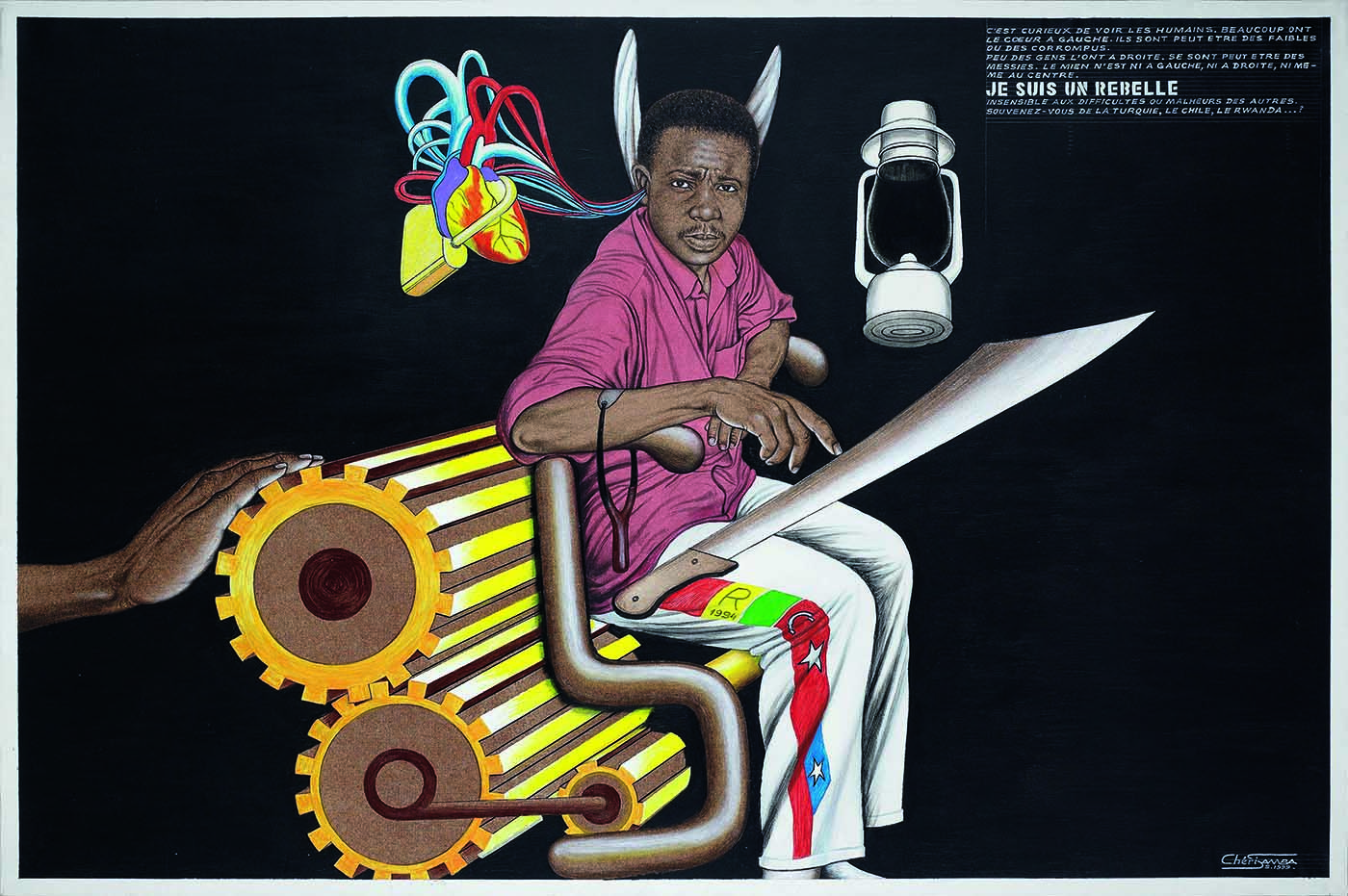
The “Africa Now” auction of African art is the only one of its kind in the world today, and this year brought in works by artists including Ben Enwonwu, El Anatsui, Malick Sidibé, Malangtana Valente Ngwenya, Yusuf Grillo, Camille Pierre Pambu Bodo, and Cheri Samba, among many others.
Hannah O’Leary, Bonhams’ Head of Contemporary African Art, commented on the auction: “This market has gone from strength to strength. While artists from at least fifteen African countries were represented, the top prices were reserved for the best pieces by the Nigerian Masters.”
Princes of Mali, an oil on board by Ben Enwonwu, was the most valuable picture in the sale, going for £92,500. Born in 1917, he was the first Nigerian to go abroad for art school training, and on his return home became Federal Art Advisor. His position as cultural ambassador to successive governments ensured him many prestigious commissions. From early on
he provided several styles of work according to client demand.
Art historian Sylvester Ogbechie contends that Enwonwu’s legacy is his contribution to the emergent national identity of Nigeria during the late 1940s and 1950s. His most famous and probably most accomplished sculpture is Anyanwu (“Eye of the Sun”), mounted on the façade of the National Museum, Lagos.
It invokes the Igbo practice of saluting the rising sun to honour ChiUkwu, the Great Spirit. Stylistically, this bronze masterpiece combines abstraction and representationalism, uniting Enwonwu’s two styles, a small-scale version making £64,900 at the sale. Ogbechie describes it as expressing “the aspirations of the Nigerian nation and Enwonwu’s personal intercession for its survival and growth”.
Yusuf Grillo’s 1972 painting “The Flight” sold for £62,500. He is one of the brilliant creative generation who graduated from the Art Department of Ahamdu Bello University (Nigeria) in the early 1960s. As his name suggests, he lived in Brazil, and he speaks Portuguese. Members of his family still live in the picturesque Brazilian quarter of Lagos.
He says: “If I were to say as a child I listened to folk stories, saw masquerades, and was put to sleep by drumming, I would be lying. I was born and brought up in the city of Lagos away from such things”. Yet the angular, expressionist style of his paintings in particular, references traditional African sculpture. And this essential Lagosian adds: “I surround myself with it, I collect it almost compulsively, and I study these sculptures, I analyse them. The clear-cut definition of planes influences my work”.
Born ten years after Yusuf Grillo, in 1944, and from Ghana, El Anatsui is not a Modernist; his work is dynamically contemporary. He studied in Kumasi during the late 1960s where an English art school curriculum was taught. “There had to be something else!” he declared, and in 1975 he joined Uche Okeke at the University of Nigeria, Nsukka, where he has lived and taught ever since.
Okeke, together with Bruce Onobrakpeya and other Nigerian artists, were known as the “Zaria Rebels”. Their manifesto, “Natural Synthesis”, appealed to Anatsui, re-interpreting indigenous cultural traditions through modern techniques and materials, though he rejected the customary artists’ materials.
He says: “Art grows out of each particular situation, and I believe that artists are better off working with whatever the environment throws up”.
Drawn by sankofa, which in Akan translates roughly as “go back and get it”, Anatsui’s practice as a sculptor developed over time. From 1980 onwards he began working with African hardwoods, including old doorposts and other found objects, using a chainsaw, which he says has a “language of violence, of tearing, of clawing, of dividing.”
He implies a metaphor for the lengthy history of violence to Africa’s culture, not just through the slave trade, but subtler manifestations such as the damage to African history, either misrepresented or left untold. The dense, hatched patterns of his carved wooden panels relate to the Ghanaian heritage of Kente and Adinkra textiles. His panel “The Clan” sold for £27,500.
In recent years he has shaken up the international art world with his glorious, unique “wall sculptures”. These sinuous, sensuous, floating metal “cloths” subvert the concept of metal as hard and rigid, metamorphosing it to soft, pliable “curtains” made of bottle caps, the detritus of urbanism. They are collected from local distilleries, then flattened and connected with copper wire. During the summer of 2013 the entire façade of London’s august Royal Academy was draped with one of these “wall sculptures”, obliterating even its name.
In 2012, the sale of his New World Map, for £541,250, broke records for a living African artist.
Then there is Sokari Douglas Camp. Born in Buguma, Nigeria, the cultural capital of the Kalabari people, Camp moved to Britain as a child and received her art education in London. “My work is about what’s going on in London,” she says, though it’s also very much a celebration of her Kalabari culture.
She is famous for the innovative way in which she translates Kalabari masquerades, festivals and other aspects of Kalabari heritage into sculptures of galvanised steel. Her Asoebi – Lace, Sweat & Tears combines the wit and compassion typical of her work, and formed the centrepiece of the “Ground Force Africa Garden” which took over the forecourt of the British Museum in 2005. She also created Cross We Bear to honour the murdered teenager Stephen Lawrence and Memorial Bus in memory of the executed Nigerian activist and writer Ken Saro-Wiwa.
The eye of Bamako
In the 1960s and 1970s everyone in Mali wanted to be photographed by the “Eye of Bamako”, Malick Sidibé. After studying photography, Sidibé began recording his famous Clubs of Bamako, and other aspects of street culture. In 1976 Sidibé stopped what he termed his “reporting work” and began taking formal studio portraits, his clients usually dressed traditionally.
He comments tellingly on the power of photography as a medium both within his own society and beyond: “Since the 1960s… we have simply concentrated on recording our own African reality without giving a thought to the possibility of the photos being seen outside of Africa. As not everyone can read and write… pictures are the only generally accessible form of communication in Africa. Without them we cannot understand the world around us. In Africa, and elsewhere as well, pictures offer instant communication”.
From Mozambique, Malangatana Valente Ngwenya, the revolutionary painter, described one of his paintings as “a vibrant thing crying to the spectator, full of heat and light that makes him cry, or creates tremors in his body”. Malangatana’s passionate, haunting canvases reflect the turmoil which his homeland Mozambique experienced pre-independence, as well as the suffering he witnessed and endured during his imprisonment by the Portuguese.
He was accused of involvement with Frelimo (the Front for Liberation of Mozambique), which he served after independence. Most of his art is a direct response to this violence and oppression, with works such as Inferno, its victims crushed together in torment. A self-portrait depicts him with tears of blood streaming from staring eyes.
Ngwenya, who was also a poet, musician and sculptor, spent his life fighting war, poverty and injustice, his work fanning the flames of resistance, which led to liberation.
Also from Mozambique, Gonçalo Mabunda had two sculptures in the show, one of which, a chair made of decommissioned weapons, sold for £10,000. Born in 1975, Mabunda grew up during the 16 years of the country’s civil war.
His sculptures of AK47s, rocket launchers, pistols and other objects of violence and destruction, are transformed into domestic objects like chairs, which metallically creak with the human cost of war. He says about his work: “These defunct arms were offered to artists for use in works that would have a ‘positive’ influence, thus opposing their former function of killing”.
That’s not all
The Democratic Republic of Congo was ably represented by the talented Camille Pierre Pambu Bodo – known as Bodo – Chéri Samba and Moke. Their passionate belief is that art has the capacity to change the course of history, and specifically their own country’s.
With stylistic references to the tortured visions of the 15th-century Dutch painter Hieronymous Bosch, Bodo has produced works like The River of Delight. In an idyll of hedonism nude men and women gambol innocently in and out of the river, a flower growing out of the bottom of one of them. One of Bodo’s early themes was Ndoki Zoba, sorcery, his work urging practitioners to abandon it. “My goals are the improvement of life, and to share my dreams of a better world”.
Chéri Samba was born in 1956 and after leaving school at 16 he became an apprentice to a Kinshasa sign-painter, but he later began to produce his own billboard and comic strip art on sackcloth, because canvas was too expensive. After he opened his own studio creating authentically “popular” art, he began wondering if it was “popular” enough.
He says: “I had noticed that people in the street would walk by paintings, glance at them and keep going”. Drawing on his experience of creating comic strips with “word bubbles”, “I thought that if I added a bit of text, people would have to stop and take time to read it, to get more into the painting… From then on, I put text in all my paintings”.
And from the early 1980s onwards he began signing himself Chéri Samba: Artiste Populaire. So universally popular did his work become, that it began gaining an international audience and exhibition exposure, with its highly politicised and satirical subject matter, subtly laced with sex and violence.
Yet he insists that he paints for Africans, to open their eyes: “My paintings are concerned with people’s lives – I’m not interested in myths or beliefs. That’s not my goal. I want to change our mentality that keeps us isolated from the world. There’s poverty, stupidity, corruption, chaos, universal decadence… I appeal to people’s consciences. Artists should enable people to think”.
With their commentaries on the political, economic, social and cultural realities of Africa, these artists certainly are “making people think”.