
Naira devaluation made Nigeria poor, Obasanjo says
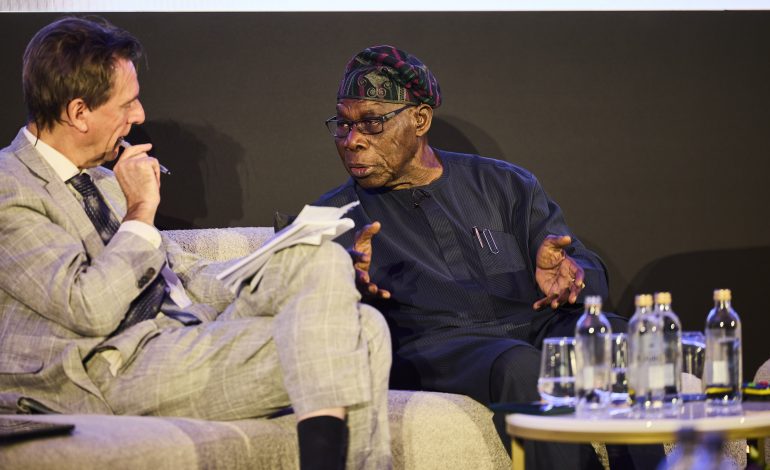
At the FT Africa summit, retired president Olusegun Obasanjo explores Nigeria’s economy, Horn of Africa tensions, and why he’s still not ready to retire.
Nigeria’s retired president Olusegun Obasanjo has said that the naira devaluation made the country “the poverty capital of the world.”
Within three months in 2023, President Bola Tinubu’s administration removed the country’s fuel subsidy and allowed the currency to trade more freely. The naira quickly went into freefall- from an average ₦500 per dollar to around ₦1,500- a result the former president insists made every Nigerian “poorer by 300%.”
“That made Nigeria become the poverty capital of the world, which means Nigeria has the largest number of poor people in the world. You cannot say to me that that is good for Nigeria,” Obasanjo said during a keynote interview at the Financial Times Africa Summit in London on Wednesday.
The remarks mirror opinion among some economists and analysts, who argue that the country’s trade imbalance made the devaluation’s intended positive effects harder to achieve. Tinubu’s administration has defended the measures, citing the high economic costs of sustaining the subsidy and the massive distortions created by multiple forex windows.
At the three-year mark of his tenure in May 2026, President Tinubu said his administration had chosen “long-term national recovery over short-term comfort”, but he also acknowledged the economic hardships that had resulted.
“Although currency devaluation is often intended to stimulate exports and reduce imports by making domestic goods cheaper for foreign buyers and foreign goods more expensive, this mechanism has proven largely ineffective in Nigeria’s context,” a 2025 study by Adedeji D Gbadebo at Walter Sisulu University in South Africa found.
“The limited diversification of Nigeria’s export base, coupled with ongoing oil production constraints and global price volatility, has curtailed any potential gains from a weaker currency,” Adedeji added.
Governance, Geopolitics, and Ebola
According to Obasanjo, Nigeria’s fuel subsidy was never the problem in itself, but that “most of it [was] corruption.”
“If you are in a very bad economic situation, you must curb corruption,” he said, “and not spend money like a drunken sailor.”
He mulled over his own administration’s stalled negotiations with Shell, when the British multinational declined an offer to take over Nigeria’s refineries. According to Obasanjo, other than the fact that the refineries were small and not well maintained, Shell also pointed out to the corruption networks in the industry as a hindrance.
On Nigeria’s place in the West African regional dynamics, Obasanjo criticised Abuja’s decision to cut power supply to neighbouring Niger in August 2023. According to the former president, Niger had come to rely on Nigeria for its power supply after it agreed not to explore its own power generation plans on the Niger River.
Obasanjo was far more confident in the country’s ability to handle the ongoing Ebola pandemic, whose epicentre is in the DRC but whose spread has now affected four countries, including Nigeria.
“We did it before,” he said, referencing Nigeria and West Africa’s efforts in 2017 during the Ebola pandemic in West Africa.
“We can do it again, unless something has gone horribly wrong,” he added.
Just days before the summit, a 42-year-old Ugandan-born woman tested positive for the Ebola virus in Abuja, marking the first Ebola case in Nigeria in more than a decade. Officials in the country have since confirmed that the patient is the spouse of a Swiss diplomat, and are currently investigating whether the case is related to a separate positive case in Kenya that transited through Uganda.
“I am not tired yet”
Obasanjo serves as the AU’s High Representative supporting the AU’s efforts towards peace in the Horn of Africa. Part of that job included bringing, and keeping, Ethiopia’s warring parties at the negotiating table to end the 2020-2022 conflict.
With that delicate peace currently unravelling, Obasanjo is reflective, but not entirely surprised.
“We spent two years on the Pretoria Agreement on cessation of fire, displaced persons and humanitarian issues,” he added, “An agreement is not worth the paper it’s written on, unless you implement it.”
According to Obasanjo, it was already clear to him and other mediators that “both sides have given up on implementation.”
But he is still hopeful they can come back to the negotiating table, and that the conflict does not escalate as Ethiopia accuses Eritrea of crossing their shared border to support the Tigrayan forces.
“We hope both sides don’t go across the border,” he said.
There are heightened diplomatic efforts to de-escalate the conflict and find a lasting path to peace, and Obasanjo may still be at the centre of it. The octogenarian, who enlisted in Nigeria’s military in 1958 and has been in some form of public service ever since, is still roaring to go where he’s needed
“I’m not tired,” he said, adding that his children have been asking him as well, “when I’m tired, I will retire.”


